


Page 259 - Fisika Terapan for Engineers and Scientists
P. 259
Problems                              459


                         When an unknown mass is placed on the inner pan, the  59. Consider the differential windlass illustrated in Fig. 14.30.
                         microbalance can measure changes in mass as small as  Calculate what clockwise torque must be applied to the
                         100 nanograms (1.0   10  7  g) and can measure masses up to  handle to lift a load of mass m. What tangential force must be
                         2.0 milligrams. What would you expect that the resolution  exerted on the handle? What is the mechanical advantage of
                         and maximum load for the outer pan might be?         this windlass?
                      56. A man of 73 kg stands on one foot, resting all of his weight  60. Design a block and tackle with a mechanical advantage of 4,
                         on the ball of the foot. As described in Section 14.3, the bones  and another with a mechanical advantage of 5. If you connect
                         of the foot play the role of a lever. The short end of the lever  these two arrangements in tandem, what mechanical advan-
                         (to the heel) measures 5.0 cm and the long end (to the ball of  tage do you get?
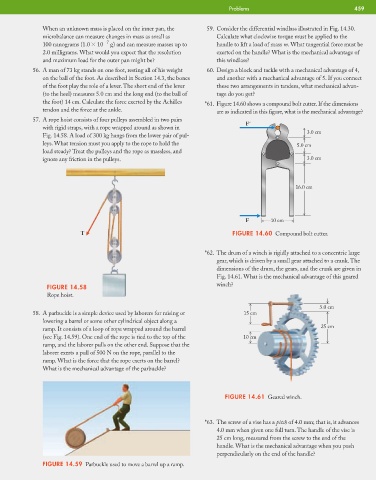
                         the foot) 14 cm. Calculate the force exerted by the Achilles  *61. Figure 14.60 shows a compound bolt cutter. If the dimensions
                         tendon and the force at the ankle.                   are as indicated in this figure, what is the mechanical advantage?
                      57. A rope hoist consists of four pulleys assembled in two pairs
                                                                                       F'
                         with rigid straps, with a rope wrapped around as shown in
                                                                                                         3.0 cm
                         Fig. 14.58. A load of 300 kg hangs from the lower pair of pul-
                         leys. What tension must you apply to the rope to hold the                    5.0 cm
                         load steady? Treat the pulleys and the rope as massless, and
                         ignore any friction in the pulleys.                                             3.0 cm


                                                                                                      16.0 cm


                                                                                       F       10 cm
                                                                                   FIGURE 14.60 Compound bolt cutter.


                                                                           *62. The drum of a winch is rigidly attached to a concentric large
                                                                              gear, which is driven by a small gear attached to a crank. The
                                                                              dimensions of the drum, the gears, and the crank are given in
                                                                              Fig. 14.61. What is the mechanical advantage of this geared
                           FIGURE 14.58                                       winch?
                           Rope hoist.
                                                                                                             5.0 cm
                      58. A parbuckle is a simple device used by laborers for raising or  15 cm
                         lowering a barrel or some other cylindrical object along a
                         ramp. It consists of a loop of rope wrapped around the barrel                        25 cm
                         (see Fig. 14.59). One end of the rope is tied to the top of the  10 cm
                         ramp, and the laborer pulls on the other end. Suppose that the
                         laborer exerts a pull of 500 N on the rope, parallel to the
                         ramp. What is the force that the rope exerts on the barrel?
                         What is the mechanical advantage of the parbuckle?


                                                                                 FIGURE 14.61 Geared winch.


                                                                           *63. The screw of a vise has a pitch of 4.0 mm; that is, it advances
                                                                              4.0 mm when given one full turn. The handle of the vise is
                                                                              25 cm long, measured from the screw to the end of the
                                                                              handle. What is the mechanical advantage when you push
                                                                              perpendicularly on the end of the handle?
                         FIGURE 14.59 Parbuckle used to move a barrel up a ramp.

