


Page 31 - Fisika Terapan for Engineers and Scientists
P. 31
Problems                              231


                                                                9
                         sion of 1 short ton (2000 lb) of TNT releases 4.2   10 J. How  baseball when it reaches the highest point of its trajectory?
                         many tons of TNT release the same energy as the avalanche?  Ignore friction.
                      62. A parachutist of mass 60 kg jumps out of an airplane at an  *73. A jet aircraft looping the loop (see Problem 70 in Chapter 4)
                         altitude of 800 m. Her parachute opens and she lands on the  flies along a vertical circle of diameter 1000 m with a speed of
                         ground with a speed of 5.0 m/s. How much energy has been  620 km/h at the bottom of the circle and a speed of 350 km/h
                         lost to air friction in this jump?                   at the top of the circle. The change of speed is due mainly to
                                                                              the downward pull of gravity. For the given speed at the
                      63. A block released from rest slides down to the bottom of a plane
                                                                              bottom of the circle, what speed would you expect at the top
                         of incline 15  from a height of 1.5 m; the block attains a speed of
                                                                              of the circle if the thrust of the aircraft’s engine exactly bal-
                         3.5 m/s at the bottom. By considering the work done by gravity
                                                                              ances the friction force of air (as in the case for level flight)?
                         and the frictional force, determine the coefficient of friction.
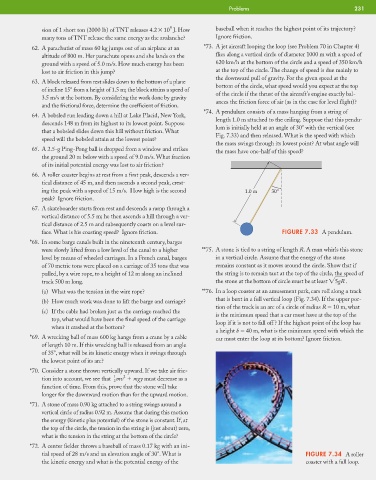
                                                                          *74. A pendulum consists of a mass hanging from a string of
                      64. A bobsled run leading down a hill at Lake Placid, New York,
                                                                              length 1.0 m attached to the ceiling. Suppose that this pendu-
                         descends 148 m from its highest to its lowest point. Suppose
                                                                              lum is initially held at an angle of 30  with the vertical (see
                         that a bobsled slides down this hill without friction. What
                                                                              Fig. 7.33) and then released. What is the speed with which
                         speed will the bobsled attain at the lowest point?
                                                                              the mass swings through its lowest point? At what angle will
                      65. A 2.5-g Ping-Pong ball is dropped from a window and strikes
                                                                              the mass have one-half of this speed?
                         the ground 20 m below with a speed of 9.0 m/s. What fraction
                         of its initial potential energy was lost to air friction?
                      66. A roller coaster begins at rest from a first peak, descends a ver-
                         tical distance of 45 m, and then ascends a second peak, crest-
                         ing the peak with a speed of 15 m/s. How high is the second   1.0 m   30°
                         peak?  Ignore friction.
                      67. A skateboarder starts from rest and descends a ramp through a
                         vertical distance of 5.5 m; he then ascends a hill through a ver-
                         tical distance of 2.5 m and subsequently coasts on a level sur-
                         face. What is his coasting speed?  Ignore friction.                      FIGURE 7.33 A pendulum.
                     *68. In some barge canals built in the nineteenth century, barges
                         were slowly lifted from a low level of the canal to a higher  **75. A stone is tied to a string of length R. A man whirls this stone
                         level by means of wheeled carriages. In a French canal, barges  in a vertical circle. Assume that the energy of the stone
                         of 70 metric tons were placed on a carriage of 35 tons that was  remains constant as it moves around the circle. Show that if
                         pulled, by a wire rope, to a height of 12 m along an inclined  the string is to remain taut at the top of the circle, the speed of
                         track 500 m long.                                    the stone at the bottom of circle must be at least 25gR .
                         (a) What was the tension in the wire rope?       **76. In a loop coaster at an amusement park, cars roll along a track
                                                                              that is bent in a full vertical loop (Fig. 7.34). If the upper por-
                         (b) How much work was done to lift the barge and carriage?
                                                                              tion of the track is an arc of a circle of radius R   10 m, what
                         (c) If the cable had broken just as the carriage reached the
                                                                              is the minimum speed that a car must have at the top of the
                            top, what would have been the final speed of the carriage
                                                                              loop if it is not to fall off? If the highest point of the loop has
                            when it crashed at the bottom?
                                                                              a height h   40 m, what is the minimum speed with which the
                     *69. A wrecking ball of mass 600 kg hangs from a crane by a cable  car must enter the loop at its bottom? Ignore friction.
                         of length 10 m. If this wrecking ball is released from an angle
                         of 35 , what will be its kinetic energy when it swings through
                         the lowest point of its arc?
                     *70. Consider a stone thrown vertically upward. If we take air fric-
                                               1
                                                  2
                         tion into account, we see that  mv   mgy must decrease as a
                                               2
                         function of time. From this, prove that the stone will take
                         longer for the downward motion than for the upward motion.
                     *71. A stone of mass 0.90 kg attached to a string swings around a
                         vertical circle of radius 0.92 m. Assume that during this motion
                         the energy (kinetic plus potential) of the stone is constant. If, at
                         the top of the circle, the tension in the string is (just about) zero,
                         what is the tension in the string at the bottom of the circle?
                     *72. A center fielder throws a baseball of mass 0.17 kg with an ini-
                         tial speed of 28 m/s and an elevation angle of 30 . What is                     FIGURE 7.34 A roller
                         the kinetic energy and what is the potential energy of the                      coaster with a full loop.

