


Page 26 - Fisika Terapan for Engineers and Scientists
P. 26
226                                CHAPTER 7  Work and Energy


                QUESTIONS FOR DISCUSSION

                  1. Does the work of a force on a body depend on the frame of  ground) is instantaneously at rest if the wheel is not slipping.
                    reference in which it is calculated? Give some examples.  What force gives the body of the automobile energy? Where
                  2. Does your body do work (external or internal) when standing  does this energy come from? (Hint: Consider the force that
                    at rest? When walking steadily along a level road?   the rear axle exerts against its bearings.)
                  3. Consider a pendulum swinging back and forth. During what  9. Why do elevators have counterweights? (See Fig. 5.40.)
                    part of the motion does the weight do positive work? Negative  10. A parachutist jumps out of an airplane, opens a parachute, and
                    work?                                                lands safely on the ground. Is the mechanical energy for this
                          2
                                      2
                                                       1
                                                          2
                              2
                                  2
                  4. Since v   v   v   v , Eq.(7.23) implies K   mv      motion conserved?
                             x   y   z                 2   x
                     1 mv   mv . Does this mean that the kinetic      11. If you release a tennis ball at some height above a hard floor, it
                        2
                              2
                          1
                     2  y   2  z
                    energy has x, y, and z components?                   will bounce up and down several times, with a gradually
                  5. Consider a woman steadily climbing a flight of stairs. The  decreasing amplitude. Where does the ball suffer a loss of
                    external forces on the woman are her weight and the normal  mechanical energy?
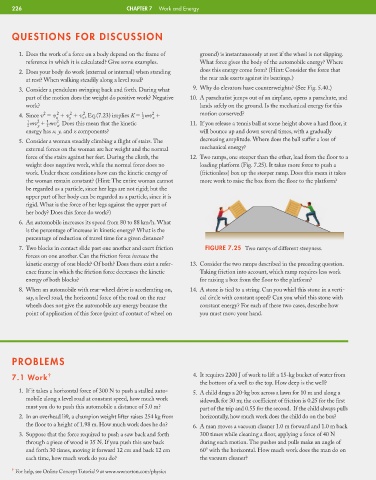
                    force of the stairs against her feet. During the climb, the  12. Two ramps, one steeper than the other, lead from the floor to a
                    weight does negative work, while the normal force does no  loading platform (Fig. 7.25). It takes more force to push a
                    work. Under these conditions how can the kinetic energy of  (frictionless) box up the steeper ramp. Does this mean it takes
                    the woman remain constant? (Hint: The entire woman cannot  more work to raise the box from the floor to the platform?
                    be regarded as a particle, since her legs are not rigid; but the
                    upper part of her body can be regarded as a particle, since it is
                    rigid. What is the force of her legs against the upper part of
                    her body? Does this force do work?)
                  6. An automobile increases its speed from 80 to 88 km/h. What
                    is the percentage of increase in kinetic energy? What is the
                    percentage of reduction of travel time for a given distance?
                  7. Two blocks in contact slide past one another and exert friction  FIGURE 7.25 Two ramps of different steepness.
                    forces on one another. Can the friction force increase the
                    kinetic energy of one block? Of both? Does there exist a refer-  13. Consider the two ramps described in the preceding question.
                    ence frame in which the friction force decreases the kinetic  Taking friction into account, which ramp requires less work
                    energy of both blocks?                               for raising a box from the floor to the platform?
                  8. When an automobile with rear-wheel drive is accelerating on,  14. A stone is tied to a string. Can you whirl this stone in a verti-
                    say, a level road, the horizontal force of the road on the rear  cal circle with constant speed? Can you whirl this stone with
                    wheels does not give the automobile any energy because the  constant energy? For each of these two cases, describe how
                    point of application of this force (point of contact of wheel on  you must move your hand.


                PROBLEMS

                7.1 Work   †                                           4. It requires 2200 J of work to lift a 15-kg bucket of water from
                                                                         the bottom of a well to the top. How deep is the well?
                  1. If it takes a horizontal force of 300 N to push a stalled auto-  5. A child drags a 20-kg box across a lawn for 10 m and along a
                    mobile along a level road at constant speed, how much work  sidewalk for 30 m; the coefficient of friction is 0.25 for the first
                    must you do to push this automobile a distance of 5.0 m?  part of the trip and 0.55 for the second. If the child always pulls
                  2. In an overhead lift, a champion weight lifter raises 254 kg from  horizontally, how much work does the child do on the box?
                    the floor to a height of 1.98 m. How much work does he do?  6. A man moves a vacuum cleaner 1.0 m forward and 1.0 m back
                  3. Suppose that the force required to push a saw back and forth  300 times while cleaning a floor, applying a force of 40 N
                    through a piece of wood is 35 N. If you push this saw back  during each motion. The pushes and pulls make an angle of
                    and forth 30 times, moving it forward 12 cm and back 12 cm  60  with the horizontal. How much work does the man do on
                    each time, how much work do you do?                  the vacuum cleaner?
                †
                 For help, see Online Concept Tutorial 9 at www.wwnorton.com/physics

