


Page 27 - Fisika Terapan for Engineers and Scientists
P. 27
Problems                              227


                       7. A record for stair climbing was achieved by a man who raced  15. A constant force of 25 N is applied to a body while it moves
                         up the 1600 steps of the Empire State Building to a height of  along a straight path for 12 m. The force does 175 J of work
                         320 m in 10 min 59 s. If his average mass was 75 kg, how  on the body. What is the angle between the force and the
                         much work did he do against gravity? At what average rate (in  path of the body?
                         J/s) did he do this work?                        *16. A strong, steady wind provides a force of 150 N in a direction
                       8. Suppose you push on a block sliding on a table. Your push has  30  east of north on a pedestrian. If the pedestrian walks first
                         a magnitude of 50 N and makes a downward angle of 60  with  100 m north and then 200 m east, what is the total work done
                         the direction of motion. What is the work you do on the block  by the wind?
                         while the block moves a distance of 1.6 m?       *17. A man pulls a cart along a level road by means of a short rope
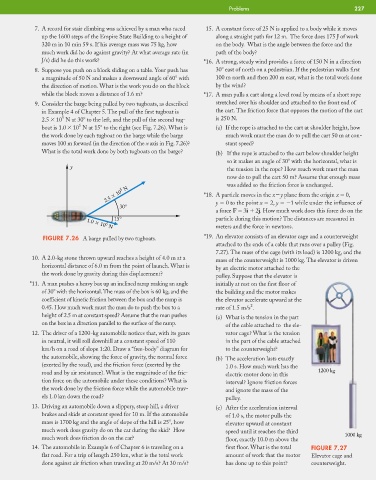
                       9. Consider the barge being pulled by two tugboats, as described  stretched over his shoulder and attached to the front end of
                         in Example 4 of Chapter 5. The pull of the first tugboat is   the cart. The friction force that opposes the motion of the cart
                               5
                         2.5   10 N at 30  to the left, and the pull of the second tug-  is 250 N.
                                    5
                         boat is 1.0   10 N at 15  to the right (see Fig. 7.26). What is  (a) If the rope is attached to the cart at shoulder height, how
                         the work done by each tugboat on the barge while the barge  much work must the man do to pull the cart 50 m at con-
                         moves 100 m forward (in the direction of the x axis in Fig. 7.26)?  stant speed?
                         What is the total work done by both tugboats on the barge?  (b) If the rope is attached to the cart below shoulder height
                                                                                 so it makes an angle of 30  with the horizontal, what is
                                  y
                                                                                 the tension in the rope? How much work must the man
                                                                                 now do to pull the cart 50 m? Assume that enough mass
                                                                                 was added so the friction force is unchanged.
                                            2.5       10  N               *18. A particle moves in the x y plane from the origin x   0,
                                                 5
                                                 30°                          y   0 to the point x   2, y   1 while under the influence of
                                                                              a force F   3i   2j. How much work does this force do on the
                                               15°                            particle during this motion? The distances are measured in
                                            5
                                                                              meters and the force in newtons.
                                       1.0     10  N
                         FIGURE 7.26 A barge pulled by two tugboats.      *19. An elevator consists of an elevator cage and a counterweight
                                                                              attached to the ends of a cable that runs over a pulley (Fig.
                                                                              7.27). The mass of the cage (with its load) is 1200 kg, and the
                      10. A 2.0-kg stone thrown upward reaches a height of 4.0 m at a
                                                                              mass of the counterweight is 1000 kg. The elevator is driven
                         horizontal distance of 6.0 m from the point of launch. What is
                                                                              by an electric motor attached to the
                         the work done by gravity during this displacement?
                                                                              pulley. Suppose that the elevator is
                     *11. A man pushes a heavy box up an inclined ramp making an angle  initially at rest on the first floor of
                         of 30  with the horizontal.The mass of the box is 60 kg, and the  the building and the motor makes
                         coefficient of kinetic friction between the box and the ramp is  the elevator accelerate upward at the
                                                                                        2
                         0.45. How much work must the man do to push the box to a  rate of 1.5 m/s .
                         height of 2.5 m at constant speed? Assume that the man pushes  (a) What is the tension in the part
                         on the box in a direction parallel to the surface of the ramp.  of the cable attached to  the ele-
                      12. The driver of a 1200-kg automobile notices that, with its gears  vator cage? What is the tension
                         in neutral, it will roll downhill at a constant speed of 110  in the part of the cable attached
                         km/h on a road of slope 1:20. Draw a “free-body” diagram for  to the counterweight?
                         the automobile, showing the force of gravity, the normal force  (b) The acceleration lasts exactly
                         (exerted by the road), and the friction force (exerted by the  1.0 s. How much work has the
                         road and by air resistance). What is the magnitude of the fric-  electric motor done in this  1200 kg
                         tion force on the automobile under these conditions? What is  interval? Ignore friction forces
                         the work done by the friction force while the automobile trav-  and ignore the mass of the
                         els 1.0 km down the road?                               pulley.
                      13. Driving an automobile down a slippery, steep hill, a driver  (c) After the acceleration interval
                         brakes and skids at constant speed for 10 m. If the automobile  of 1.0 s, the motor pulls the
                         mass is 1700 kg and the angle of slope of the hill is 25 ,how  elevator upward at constant
                         much work does gravity do on the car during the skid?  How  speed until it reaches the third
                         much work does friction do on the car?                  floor, exactly 10.0 m above the     1000 kg
                      14. The automobile in Example 6 of Chapter 6 is traveling on a  first floor. What is the total  FIGURE 7.27
                         flat road. For a trip of length 250 km, what is the total work  amount of work that the motor  Elevator cage and
                         done against air friction when traveling at 20 m/s? At 30 m/s?  has done up to this point?  counterweight.

