


Page 28 - Fisika Terapan for Engineers and Scientists
P. 28
228                                CHAPTER 7  Work and Energy


                 *20. By means of a towrope, a girl pulls a sled loaded with firewood  F x
                    along a level, icy road.The coefficient of friction between the sled
                    and the road is    0.10, and the mass of the sled plus its load is
                                k
                    150 kg.The towrope is attached to the front end of the sled and  2 N
                    makes an angle of 30  with the horizontal. How much work
                                                                                1
                    must the girl do on the sled to pull it 1.0 km at constant speed?
                                                                                                        x
                 *21. During a storm, a sailboat is anchored in a 10-m-deep harbor.
                                                                                0     2    4    6    8  m
                    The wind pushes against the boat with a steady horizontal
                    force of 7000 N.                                           –1
                    (a) The anchor rope that holds the boat in place is 50 m long
                                                                               –2
                       and is stretched straight between the anchor and the boat
                       (Fig. 7.28a). What is the tension in the rope?
                                                                             FIGURE 7.29 Position-dependent force.
                    (b) How much work must the crew of the sailboat do to pull
                       in 30 m of the anchor rope, bringing the boat nearer to
                                                                      25. When an ideal, horizontal spring is at equilibrium, a mass
                       the anchor (Fig. 7.28b)? What is the tension in the rope
                                                                         attached to its end is at x   0. If the spring constant is 440
                       when the boat is in this new position?
                                                                         N/m, how much work does the spring do on the mass if the
                                                                         mass moves from x   0.20 m to x   0.40 m?
                          (a)
                                                                      26. The spring on one kind of mousetrap has a spring constant of
                                                                         4500 N/m. How much work is done to set the trap, by
                                                                         stretching the spring 2.7 cm from equilibrium?
                                                                     *27. To stretch a spring a distance d from equilibrium takes an
                                                                         amount W of work. How much work does it take to stretch
                                                                                 0
                                 50 m     10 m                           the spring from d to 2d from equilibrium? From Nd to
                                                                         (N   1)d from equilibrium?
                                                                     *28. A particular spring is not ideal; for a distance x from equi-
                                                                                                             3
                                                                         librium, the spring exerts a force F   6x   2x , where x is
                          (b)                                                                      x
                                                                         in meters and F is in newtons. Compared with an ideal
                                                                                     x
                                                                         spring with a spring constant k   6.0 N/m, by what factor
                                                                         does the work done by the nonideal spring exceed that done
                                                                         by the ideal spring when moving from x   0 to x   0.50 m?
                                                                         From x   1.0 m to x   1.5 m? From x   2.0 m to x   2.5 m?
                             20 m  10 m                              *29. The ends of a relaxed spring of length l and force constant k are
                                                                         attached to two points on two walls separated by a distance l.
                                                                         (a) How much work must you do to push the midpoint of the
                    FIGURE 7.28 A sailboat at anchor.                       spring up or down a distance y (see Fig. 7.30)?
                                                                         (b) How much force must you exert to hold the spring in this
                                                                            configuration?
                                                                     *30. A particle moves along the x axis from x   0 to x   2.0 m. A
                                                                                    2
                7.2 Work for a Variable Force       †                    force F (x)  2x   8x acts on the particle (the distance x is
                                                                              x
                                                                         measured in meters, and the force in newtons). Calculate the
                 22. The spring used in the front suspension of a Triumph sports  work done by the force F (x) during this motion.
                                                                                           x
                                               4
                    car has a spring constant k   3.5   10 N/m. How much work
                    must you do to compress this spring by 0.10 m from its
                    relaxed condition? How much more work must you do to
                    compress the spring a further 0.10 m?
                                                                              y
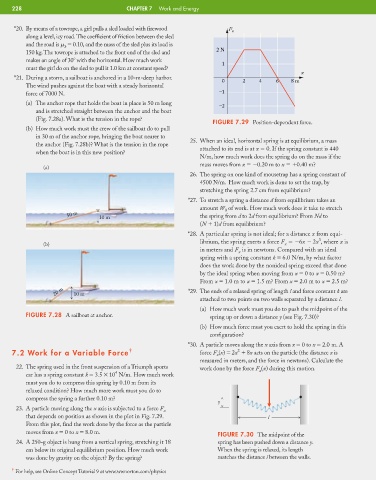
                 23. A particle moving along the x axis is subjected to a force F
                                                              x
                    that depends on position as shown in the plot in Fig. 7.29.               l
                    From this plot, find the work done by the force as the particle
                    moves from x   0 to x   8.0 m.
                                                                              FIGURE 7.30 The midpoint of the
                 24. A 250-g object is hung from a vertical spring, stretching it 18  spring has been pushed down a distance y.
                    cm below its original equilibrium position. How much work  When the spring is relaxed, its length
                    was done by gravity on the object? By the spring?         matches the distance l between the walls.
                †
                 For help, see Online Concept Tutorial 9 at www.wwnorton.com/physics

