


Page 103 - NAVAL SCIENCE 3 TEXTBOOK
P. 103
The Challenge of Leadership


         111  Nnm/ Science 2 YOll were introduced to basic principles of le<1d~   Navy is made up of people, navallei\(.krs llluSt learn to understand
         ership  thilt  wiJI  help  you  rise  to  higher  levels of responsibility in   and value the mallY individuals with whom they must work.
         your NJROTC unit ilnd in  other life activities  in  which you mnr   The naval  leader  must have a philosoph)' of leadership based
         he involved. This section will exp.md on the prinriples ),oulearned   on  firmly  held  mom I values  and  integrity of character. Leaders
         earlier, and provide informat ion 011  more advanced topics YOli will   must understand  how  to  act  toward  seniors,  peers,  and  juniors.
         need as YO LI  proceed to higher lewis of leadership within  yOUI' unit   A l1::lvallcllder will be ineffective if he or she dues not understand
         and  elsewhere.  ivlall)' of the  practices and qU<llities  that arc COIll-  good leadership and ::ldministration and is not ::lble to get the team-
         man to  successful  leaders both ill the  military and  in  civilian lite   work necessaq' for the lin it  to GllTy out its mission.
         will be discussed.  In addition, some insight into the eVilluation of   Leadership  involves  human  relations-specifically  those
         performance of subordinates  will  be provided, along with infor-  between a leOlder and  ,,'  group. A leOlder  must  be able to  impose,
         mation about effective techniques of how to give instruction, both   either through command or persliOlsion, his or her will  upon that
         of which will be very  useful  to YOll as YO ll assume greater leader-  group. Also  required  is  i1 willingness on  the part  of the leOlder to
         ship roles within your unit.                           s::lcrificc  personal  time ::lnd  nmterial gain to  achieve  this person::ll
                                                                "power." Still, a person who is to  become a truly sllccessfulleader
                                                                mllst first of all have learned the principles of goocl "followl"rship,"
         Basis for Effective Leadership                         as set forth in 1\'(1\'(/1 Sciellce  J.
         Good  leadership  stresses  the  qUlllities  that  enable  a  person  to
         inspire and  nHlIlllge a group of people successfully. Effective leOld-
                                                                Philosophies of Leadership
         ership, therefore, is bOlsed all persollOlI example, good orgmlization
         and administration, and persollOllmoral responsibility. The second   Philosophies of leadership ditrer widel),.  One extreme view holds
         of these,  organization  and  i.ldministmtion, deills with  a lellder's   that  leaders are  born, not  made. The opposite extreme cOlltends
         personal attention to <llld supervision of subordinates. Because the   that  anyone  who  can  master  various  leadership  principles  Ci.lll


                          15ai,


                                                                                    ,  .
                                                                              . '


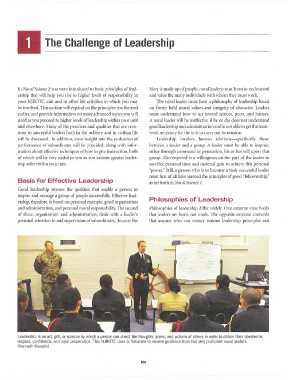
         Leadership is an  art, gift, or science by which a person  can direct the thoughts,  plans, and actions of others in order to obtain their obedience,
         respect, confidence, and loyal  cooperation. This NJROTC class is fortunate to receive guidance from two very  proficient naval  leaders.
         (Kenneth  Hendrix)


                                                            108

