


Page 108 - NAVAL SCIENCE 3 TEXTBOOK
P. 108
l NTE HNXl'l ONAL  LAW  AND  T11E  SEA   113


                                                                acquire  the  qualities  he or she needs for sllccess. \·Vhen  leaders'
                                                                conduct  is  outstanding, those around them  are often  inspired  to
                                                                pattern  their  own  actions after  them,  to  the good  of the whole
                                                                organization. No  leader, then, can  live by the rule of "Do as  I say,
                                                                not as  I do." It will  not work. As  many recent e\'Cnts have shown,
                                                                lllallY bad things  can happen to elected, appointed, and cOlllmis-
                                                                sioned and noncommissioned military <md civiliallieaders  jf what
                                                                they do in their private lives is not .. lS exemplary as their public rllld
                                                                professional lives.
                                                                   No leader can ignore rules and regulations and still expect sub-
                                                                ordinates to follow them. Such a leader will not be trusted and will
                                                                lose control of subordinates.  Regaining respect and  control once
                                                                they ore lost is exceptionally difficult.
                                                                   Rank has its privileges, but that does not excuse improper con-
                                                                duct. Rather, when it comes to  conduct, it should be stressed that
                                                                rank also  has its responsibilities. "Conduct" in  the military means
                                                                conduct  ashore,  as  well  as  aboard  ship  or station. No  good citi-
                                                                zen  and  certainly  no  service  member would  do  anything to  dis-
                                                                honor the uniform, for such conduct can bring dishonor upon the
                                                                United Sti1tes and its armed forces.
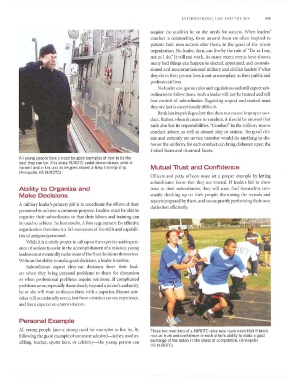
         All  young people  have  a need  for good  examples of how  to  be  the
         best they can  be.  This sharp NJROTC cadet demonstrates pride in
         himself and  in  his unit as  he goes aboard  a Navy train ing ship.   Mutual Trust and Confidence
         (Annapolis HS  NJROTC)
                                                                Officers and  pett),  officers  must  set  a proper example  by letting
                                                                subordinates know  that  they  are trusted.  If leaders  fail  to  show
         Ability to Organize and                                trust  in their  subordinates,  they  will  soon  find  themselves  COI1-
         Make Decisions                                         stillltly checking up  on  their  people,  distrusting  the records  and
                                                                reports prepared by them, and consequently pertorming their own
         A military leader's primary job is to coordinate the eft-orts of their
                                                                duties less efficiently.
         personnel to achieve a common purpose. Leaders must be able to
         organize  their  subordinates  so  that  their  labors and training can
         be used to achieve the best results. A first  requirement tor effective
         organization therefore is a full awareness of the skills and capabili-
         ties of assigned personnel.
            \"'hile it is entirely proper to call  upon the expertise and experi-
         ence of seniors to assist in the accomplishment of a mission, young
         leaders must eventually make 1110st of the final decisions themselves.
         \Vithout the ability to make good decisions, a leader is useless.
            Subordinates  expect  clear-cut  decisions  from  their  lead-
         ers  when  they  bring  personal  problems  to  them  for  discussion
         or  when  professional  problems  require solutions. If complicated
         problems arise, especially those clenrly beyond n junior's authority,
         he or she  will  want to  discllss them with n superior.  Honesl  mis-
         takes will occasionally occur, but from  mistakes comes experience,
         and from experience comes wisdom.


         Personal Example
         All  young people  have  a strong need  for  examples  to  live  by.  By   These  two members of a NJROTC  relay race team  know that  it takes
         following the good example of someone admired-father, mother,   mutual trust and  confidence in  each other's ability to make a good
         sibling,  teacher, sports hero, or celebrity-the  young  person  (an   exchange of the  baton  in  the stress of competition. (Annapolis
                                                                HS  NJROTC)

