


Page 105 - NAVAL SCIENCE 3 TEXTBOOK
P. 105
110     I.EADEItS HI P

                                                              STUDY GUIDE QUESTIONS

                                                               1.  'Vhat is the challenge of leadership?
                                                              2.  Upon what is effective leadership based?
                                                              3.  ' Vhat are the two extremes in philosophy of leadership?
                                                              4.  \Vhat is the fi rst lesson that militaqr personneIlllllst learn?
                                                              5.  \Vh)' must military personnel have a morc idei.llistic outlook
                                                                 0 11  the importance of obedience?
                                                              6.  A.  \Vhat arc the two forms of military obedience?
                                                                 ll.  \Vhy is there a need for each?
                                                              7.  ' Vhilt is the difference between a senior's request or order and
                                                                 a command?
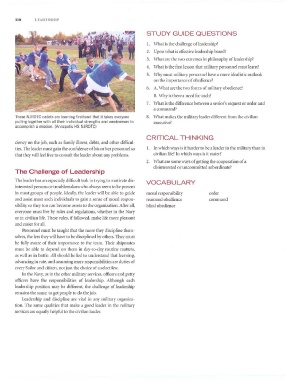
       These NJROTC cadets are learning firsthand that  it takes everyone   8.  ' Vhat makes the military leader difterent from  the civilian
       pulling together with all  their individual strengths and weaknesses to   executive?
       accomplish a mission. (Annapolis HS NJROTC)
                                                              CRITICAL  THIN K ING
       ciency on Ihe job. such as  family iliness. debts. and 01 her diflicul-
       ties. The leader must gtlin the confidence of his or her personnel so   I.  In which ways is it harder to be a leader in the military than in
       that the)' wiU feel free to consult the leader about an)' problems.   civilian life?  In which wa),s is it easier?
                                                              2.  \"hat are some ways of getting the cooperation of a
                                                                 disinterested or uncommitted subordinate?
       The Challenge of  Leadership

       The leader htls illl especially difl1cult task in trying to motivate dis-
                                                              VOCABUL ARY
       interested persons or troublemakers who always seem to be present
       in mosl groups of people.  Ideally.  the leader will  be able 10  guide   Illoral responsibUit)'   order
       and assist most slich individuals to gain a sense of moral respon-  reasoned obedience   command
       sibility so the)' too can become assets to the organization. After all,   blind obedience
       everyone IllllSt  live by rules and regulations, whether in the Navy
       or in civilian life. These rules, if followed, make life mure pleasant
       and easier for all.
          Personnel l11l1st  be taught that the more they discipline them-
       selves. the less Ihey will have to be disciplined by others. They must
       be fully aware of their  importance  to the  tealll.  Their shipmates
       Illust  be able to  depend  on them  in day-to-day routine matters,
       as well  as in  battle. All  should be led to understand  that learning,
       advancing in rate, and assuming more responsibilities are duties of
       ever)' Sailor and citizen, not just the choice of a select fe\\'.
          In the Navy, as in the other military services, officers and petty
       officers  ha\'e  the  responsibilities  of  leadership.  Although  each
       leadership  posilion may be  different. the  challenge  of leadership
       remains the same: to get people to do the job.
          Leadership and discipline are vital in  any  milit<1q' organiza-
       tion. The same qualities  that make  ;l good  leader in the military
       services arc equaily helpful to the civilian leader.

