


Page 106 - NAVAL SCIENCE 3 TEXTBOOK
P. 106
fJ Qualities of a Leader


         No  two  leaders  are  exactly  alike.  They  do  not  possess  the  same   initiative to learn about tasks and billets demanding increased lev-
         !miIS;  neither do they accomplish their goals in the S<lme ways. All   els of responsibility. Positive recommendations, advancements, and
         grroH  leaders,  however, have  certain  characteristics  and  nbilities.   promotions are likely to result ti'om such performance of duty.
         Not evcry leader will possess every quality disclIssed here,  but all   A young person showing ambition on the job in a ci\'ilian firm
         will have many of them. It stands to reason that it is important for   is  considered  a valuabJe asset;  such a person might  e\'entually be
         a leader with less natural ability to work on those qualities needed   considered  for a management role.  I\,lere ambition  is  not  enough
         to become morc cfTectivt'.                             in the militaql service, however. All  in the militar), are expected to
                                                                ploee dut), obO\'e selt: All must do their dut), to the best of their abil-
                                                                ity at all times-not because of the personnl gnin that might occur,
         Moral Responsibility                                   but because that is the best way to accomplish the mission. The unit
         A high sense of moral responsibility is one of the most important   might I~lil in its mission if some individuals ':liJ to do their part.
         leadership chnracteristics. AJI  truly great leaders have had personal
         codes  of conduct that would  not permit them  to  lise  their abili-
         ties and positions to  take unfair advantage of their fellow citizens
         or subordinates.
            Most of us understand  the  written  and  unwritten Jaws  that
         guide  OU]'  actions and  know  that  appropriate  punishments  will
         likely result if we break them. It is more difficult, however, to define
         mOrilllaws,  since  Illost of these  cannot  be legally enforced.  Each
         person must establish these laws for himself or herself. Depending
         upon the person's character, the sense of moral responsibility may
         be extensive or almost nonexistent. The only enforcer is the indi-
         vidual's own conscience.


         Loyalty
         LO),;'llty means f..1ithful and enthusiastic devotion to one's cOllnt!')',
         organization, and associates.  In  the military this must  be broad-
         ened to include one's superiors and subordinates.  Ever)'one IllUSt
         eom the right to loyalt)"
            Lo)'alt)' is a two-way street. Subordinates arc particularly sen-
         sitive about loyalty extending downward to them and arc quick to
         notice when it is absent. The loyalty of a senior toward his or her
         personnel has a great effect on the morale within the organization,
         and this may translate into that extra effort that is so often neces-
         sary to accomplish a mission.


         Devotion to Duty
         Devotion  to duty ma)' be defined os loyalt)' to the position or job
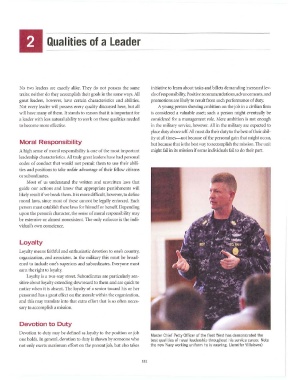
                                                                Master Chief Petty Officer of the fleet West has demonstrated the
         one holds.  In general, devotion to duty is shown by someone who   best qualities of naval  leadership throughout his service career.  Note
         not only exerts maximulll ettort on the present job, but also takes   the  new  Navy working uniform  he  is wearing.  (Jenni fer Villalovos)


                                                             III

