


Page 130 - NAVAL SCIENCE 3 TEXTBOOK
P. 130
SIIIP CO NSTR UCTION AND  DAl\IAC,E  CO NT ROL   135

         The section of the ship  around the  midpoint area  is  called amid-  age from collision or grounding. The spaces between the inner and
         ships. Sightings by lookouts are noted and reported as bei.ng off the   outer bottoms may  form  tauks  or bilges,  which  may be  used  for
         port or starboard bow or beam, and off the port or starboard quar-  fuel  and water stowage or bal1ast (usually concrete or pig iron).  If
         ter (area abaft of the beam toward thc stern).         they are empty, they arc called J10ids (air spaces).
            You  never  go  downstairs  in  a ship;  you  always  go  bela IV.  To   Many of these tanks are fitted with pumps that can transfer liq-
         go  up to the main deck or above is  to go topside.  However, if you   uids from one tank compartment to another to help keep the ship
         climb  the mast, stacks, rigging, or any other areas above the solid   level or "all an even kee\." The tanks at the extreme bow and stern,
         structure of the ship, you go aloft.                   called the forward  (or forepeak)  and after peak tnllks, are used  for
                                                                tril1l//ling the ship (leveling it fore-and-aft).
                                                                   The top of the main hull is called the //lain deck. The intersec-
         S hip Structure
                                                                tion of the  main  deck with  the shell  or side plating is  called  the
         The hull is the main body of the ship. It is like a box. Its inner con-  gllnwale (pronounced gUIl'el). Projections at the joint between the
         struction might be compared to  the girders of a sted bridge. The   side plating and the bottom plating are called bilge keels;  their pur-
         keel is the backbone of the hull; it is on the centerline like an I-beam   pose is to reduce rol1ing of the ship. (A ship rolls from side to side;
         running the full  length of the bottom of the ship, with heavy cast-  it pitches when it goes up and down  fore and aft; it yaws when the
         ings fore and aft called the stem and stem posts. Girders attached to   bow swings to port and starboard because of wave action.)
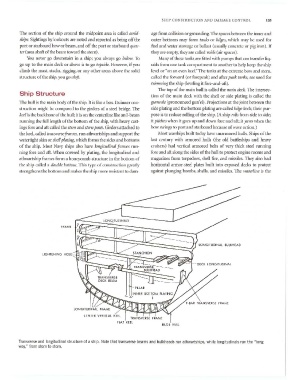
         the keel, cill1cd trmlSl'erse frallles,  run athwartships and support the   ivlost warships built today have unarmored hulls. Ships of the
         wi.ltertight skin or shell platillg, which forms the sides and bottoms   last  cenhlry with  armored  hulls  (the  old  battleships  and  heavy
         of the ship.  Most  Nav)' ships also  have  /Ollgitlldilltll frames  fun-  cruisers)  had  vertical  armored  belts  of very  thick  steel  running
         ning fore  and aft. \,"hen covered by plating, the longitudinal and   fore and aft along the sides of the hull to protect engine rooms and
         athwartship frames form a honcycomb structure in the bottolll of   magazi.nes from  torpedoes, shell  nre, and  missiles. They also  had
         the ship called a double llOtt011l.  This type of construction greatly   horizontal armor-steel  plates built  into exposed  decks  to  protect
         strengthens the bottom and 111i.lkes the ship Illore resistant to dal11-  against plunging bombs, shells, and missiles. The I\'aterlinc is  the


                           fRAME


                                  f~:~~::::IT::::~:;:::~~~:~;;;;;~' LONGITUDINAL  BULKHEAD
                   LIGHTEN ING  HOlE
                                   1:                    TRANSVERSE
                                   ~~;~~:~~~~f~~~~~~5~;i;~-- DECK  LONGITUDINAL
                                                             BULKHEAD


                                    CENTER  VERTICAL  KEEL
                                                                     BILGE  KEEL


         Transverse and  longitudinal structure of a ship.  Note that transverse  beams and  bulkheads run athwartships,  while longitudinals run the "long
         way,"  from stem  to stern.

