


Page 132 - NAVAL SCIENCE 3 TEXTBOOK
P. 132
SH IP  CONSTH UCTIO N  AND  DA~IAGE CONTROL   137

             The  term  lW!(/t"er  deck  includes  all  parts  of decks  that  ar('   The top of a mast is called the trtlck. The pigsrick is  <1  slender
          exposed to the w(';Hher. Blilwarks are a sort of low, solid-steel fence   vertical  ex1ension above the Illast from  which  the ship's commis-
          along the gunwale of the  main deck, fitted  with sCllppers,  rubber   sion pennant is flown. The galT extends abaft of the mainmast.  It
          or metal drains that allow water to run off the deck during rain or   is from  the gaff that the national ensign is flown when the ship is
          heavy seas.                                            under \Va)'. The small vertical pole at the bow on the forecastle and
             Any deck above the main deck, fOrCCi.lstle deck, or poop deck is   the slightly raked  (diagonal)  pole at the stern  are called the jack-
          called a sllpcrstnlctllre dcck. These decks ilre generally called lel'e/s.   staffand the j7ngstnjrrespcctivci)'. When a Navy ship is at anchor or
          The first level above the main deck is the 01  (pronounced oh-one)   moored, it flies the jack on the jackstall and the national ensign on
          level, the second  the 02 level,  and so  on.  These decks  mily  have   the tlagstaA-' from 0800 hours to SUllset.
          other names related  to  their use, such  as boat deck, signal bridge,   The stack of a ship supplies air to the main propulsion engines
          <md  llilvigating bridge.                              and exhausts smoke  and  hot gases  from  them.  Nuclear-powered
                                                                 ships do not  need stacks, because their reactors requirc no air for
          Superstructure                                         combustion, so thc)1 produce no smoke or gas.
             The slIperslrllctllre of a ship  includes all  structures  above  the
          main deck. It will vary according to the type of ship, but 1110st war-  Watertight Integrity
          ships have ;:1  pilothouse, bridge, signal bridge, chart  roOl11, combat
                                                                 In  order to  pre\'ent  the spread  of flooding,  watertight bulkheads
          information center, "radio shack," and probably a sea c.lbin for the
                                                                 <lre built in naval ships to divide the hull into a series of watertight
          captain.
                                                                 compartments. This is called watertight iniL'Srit)',  meaning sound-
             The superstructure is topped by the II/asl.  It will be at least one
          \'ertical  pole  fitted  with a  horizontal yardarm  that ex1ends above   ness  or without leaks. The more watertight compartments a ship
                                                                 has, the more secure it  will  be from  flooding. \Vatertight  integrity
          the ship and carries flag halyards (ropes) and navigational and sig-
                                                                 is intended to limit flooding, which (;:lJl cause a ship to list (lean) to
          nallights. The mast may also be in the form of a structural tripod.
                                                                 port or starboard, lose trilll (be "down" by the bow or stern), mpsize
          On  most ships there <llso  will  be  electronic devices,  radar anten-
                                                                 (tip over), or sink.
          nas,  radio aerials, and  meteorological instruments on  the mast or
                                                                    \·Vatertight doors and hatches allow access  through bulkheads
          the yardarm. iVlost Navy ships have only one lll<lst, but Illany mcr-
                                                                 and decks, respectively. Any ship could be made almost unsinkable
          chant ships and somc naval vessels have  two.  The one forward is
          called the foremast, and the one aft of this is called the mni/ll//asl;   if it  were divided  into enough watertight compartments, but too
          the  mainmast is  lIsllall)r taller than  the  foremast,  making it  nor-  much compartmentation would interfere with the arrangement of
          milll)' the highest structure above the main dcck.     mechanical equipment, ilnd C;'lSC  of movement within the ship. A
                                                                 strong watertight  bulkhead ilt  the after end  of the forepeak tank


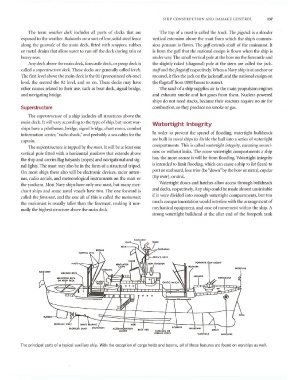
          The principal parts of a typical  auxiliary ship.  With  the exception of cargo holds and  booms, all of these  features are found on  warships as well.

