


Page 133 - NAVAL SCIENCE 3 TEXTBOOK
P. 133
138     NAVAL SKILLS

        is  called the collision lmlkhend.  If one ship rams <mother head  Oil,   After  being  raised  to  high  pressure  and  temperature in  a super-
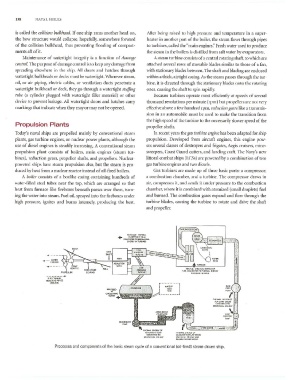
        the bow structure would collapse,  hopefully,  somewhere fonvard   heater in another part of the boiler, the steam flows through pipes
       of the collision  bulkhead, thus preventing flooding  of compart-  to turbines, called the "main engines." fresh water used to produce
        ments aft of it.                                      the steam in the boilers is distilled from salt water by evaporators.
          ivlaintenance  of watertight  integrity  is  a  function  of damage   A steam turbine consists of a central rotating shaft, to which are
       cO/it mi. The purpose of damage control is to keep an}' damage from   attached se\'eral  rows of movable blades similar to  those of a fan,
       spreading  elsewhere  in  the  ship. All  doors  and  hatches  through   with stationary blades between. The shaft and blading arc enclosed
       watertight bulkheads or decks must be watertight. \Vherever steam,   within a thick, airtight casing. As the steam passes through the tur-
       oil,  or air  piping, electric  cables,  or ventilation  ducts  penetrate a   bine,  it  is directed through the stationary blades onto the rotating
       watertight bulkhead or deck, they go  through a watertight sllIffillg   ones, causing the shaft to spin rapidly.
       tlIbe  (a  cylinder  plugged  with  watertight  filler  material)  or other   Because turbines operate most elTicientl),  ilt speeds of several
       device  to  prevent leakage.  All  watertight doors and hatches carry   thousand revolutions per minute (rpm) but propellers are not very
       markings that indicate ,,,hen they ma}' or may not be opened.   effective above a few hundred rpm, redllction genrs like a transmis-
                                                              sion  in  an  automobile mllst be used to  make the transition  from
                                                              the high speed of the turbine to the necessarily slower speed of the
       Propulsion Plants                                      propeller shafts.
       Today's  naval  ships  are  propelled  mainly by  conventional steam   In  recent years the gns lllrbille CIIgille has been adapted for ship
       plants, gas  turbine engines, or nuclear power plants, although the   propulsion.  Developed  frOlil  aircraft  engines,  this  engine  pow-
       usc of diesel  engines is steadily increasing. A conventional steam   ers several  classes of destroyers and frigates, Aegis cruisers,  mine-
       propulsion  plant  consists  of boilers,  main  engines  (steam  tur-  sweepers, Coast Guard cLitlers, and landing craft. The Navy's  new
       bines),  reduction gears, propeller shafts, and propellers.  Nuclear-  littoral combat ships (LeSs) are powered by a combination of two
       powered ships  have steam  propulsion  also, but the steam  is pro-  gas turbine engines and two diesels.
       duced by heat from a nuclear reactor instead of oil-fired  boilers.   Gas  turbines  ilrc  made up of three basic parts;  a compressor,
          A boiler consists  of a  boxlike  casing containing hundreds  of   a combustion  chamber,  and a turbine. Thc compressor draws  in
       water-filled  steel  tubes  near  the  top,  which  arc  arranged so  that   air, compresses it, and sends it under pressure to the combustion
       heat from  furnace-like fireboxes bene.:lth  passes over them, turn-  chamber, where it is combined with atomized (small droplets) fuel
       ing the water into steam. Fuel oil, sprayed into the fireboxes under   and burned. The combustion gases expand and flow through  the
       high  pressure,  ignites  and  burns  intensely,  producing  the  heat.   turbine blades, causing  the  turbine to  rotate and  drive  the shaft
                                                              and propeller.


                                                                               hUI!!:'-
                                                                             fun C~YUIUI ID I H~o.>IAI.  ~NnGV
                                                                                 IN  ~o;l [~ FII",,-,"=(
                     ------ ~
                     D:R£C'~OF
                    REACtl~£ fO~£                                     - - - --,
                      r~\lSn                                                ,
                                                                            ,
                                                                       IAI«   :
                                                           ~~.c ___ _ ____ ,


                                                             1>I("""'l £NE lIGf  Of
                                                              oW'"''''lIH'''   I>iElOU.I.  UlIOlIGTOF
                                                              CDHYUITEO 10   ~~lJl wrr (1)\,1,1)$1  11( ....
                                                             ~[(H.I.);tQ.l f""'IIGT   USlOHUI[ TO >I(A I  AKI
                                                                           Of.[ou.Tf fH OW~T U
                        Processes and components of the  basic steam  cycle of a conventional  (oil-fired) steam-driven  ship.

