


Page 134 - NAVAL SCIENCE 3 TEXTBOOK
P. 134
SHIP  CONSTRUCTION AND  [)A~.IAGE CON THOL   139


                                                                   However  it  is  produced,  propeller shafts  carry the  power  to
                                                                the  propellers.  They  run  from  the  reduction  gears  through  long
                                                Propulsion
                                          ,  ___ ,  power       wi.ltertight spaces called shaft alleys in  the very bottom of the ship.
              SIJrter                           coupling        Propellers drive the ship. Aircraft carriers and many cruisers have
                          ~==~:;:::==I Turbine                  four  propellers.  1vlost  destroyers  have  two  propellers,  but  many
                          r
                                ShJfi
                                                                newer ones  have  only one. They are  mriable-pitch  propellers,  the
                                                                blades of which can be rotated on the hub ("0 provide more or less
                 ,\uno.\pheric             Exhamt to            bite into the water for  additional control of the ship's speed or to
                 air illtah                ;Hnl05pherc
                                                                provide reverse thrust.
                        Basic parts of a gas turbine.

                                                                S hipbuilding
            The  gas  turbine  has  several  advantages  over  a  conventional
                                                                Almost  all  large  ships  constructed  in  shipyards  throughout  the
         steam plant. It is more compact, lighter, and easier to maintain and
                                                                world today are built in  dry docks. The dry docks have a number
         repair.  Because it  has a spark ignition system,  much like a car, it
                                                                of large blocks on the bottom upon  which  the hull  is  assembled.
         can go from "cold iron" shutdown to fully ready to turn the shaft in
                                                                The blocks under the ship are high enough so workers can work
         only one minute, in contrast to the several hours of warm-up time
                                                                under the hull while the ship is being built. As the hull is built, scaf-
         required to bring a steam engine on line.
                                                                folding is raised along the sides to make construction easier.
            \,Vith  a nuclear power plant, the primary system  is a circulat-
         ing water cycle.  This consists of the reactor, loops or piping, pri-
         mary coolant pumps, alld steam generators. Heat  produced in the
         reactor by nuclear fission  is  transferred to  the circulating primary
         coolant water, which is pressurized to prevent it from boiling. This
         water is then pumped by the primar}' coolant pumps through the
         steam generator, where steam to run the turbines is produced, and
         then back  into  the  reactor, where  it can  then  be  reheated  for  the
         next cycle. The steam  produced in  the generator and used to  run
         the  turbines circulates  in  a separate  loop  outside  the  reactor, to
         avoid problems with radioactivity.
            Because the generation of nuclear power does not require oxy-
         gen, submarines can operate underwater for  extended  periods of
         time. Since there are high levels of radioactivity in the reactor dur-
         ing operation, no one is  permitted to  enter the  reactor compart-
         ment.  Heavy  shielding around  the  reactor  protects  the  crew  so
         well  that they receive less  radiation  than  they would from  natural
         sources ashore.


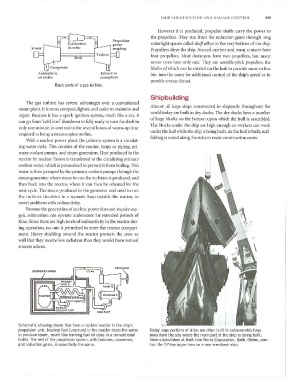
         Schematic showing steam  flow  from a nuclear reactor to the ship's
         propulsion unit. Nuclear fuel  (uranium) in  the reactor heats the water   Today  large  portions of ships are often  built in  subassembly bays
         to produce steam,  much  like  burning fuel  oil  does  in  a conventional   away  from the site where  the main part of the ship is being built.
         boiler.  The rest of the propulsion  system,  with turbines, condenser,   Here shipbuilders at  Bath  Iron Works Corporation,  Bath,  Maine,  posi-
         and  reduction gears,  is essentially the same.       tion the  97-ton  upper bow on  a new merchant ship.

