


Page 180 - NAVAL SCIENCE 3 TEXTBOOK
P. 180
186     NAVAL  SUUS


          reverse the rotation of the screw and shift the rudder long ('nollgh
          to straighten out the boat.
             Strong winds affect backing ships and  boats.  Ships with  high
          superstructures  forward, as  well  as  many  boats,  will  back  into
          strong winds, because their upperworks ;let as wE'athervanes.
             Until  YOll  discover  differentl)"  aSSUllle  that  a boat will  more
          easil), back to port.
             Boal going ahead,  screw backing. A boat going ahead  with the
          screw hacking is an  important  illustri.ltive case,  for  it  is  the uSllal
          condition  when  danger  is discO\'ered  close  abo<1rd.  Olle  might
          assullle th<1t  the rudder would have its usual effect in such <l  situ<1-
          tion, IJllllh;s;s 1I0t true. As soon <1S  the propeller st<1rts bi.leking, the
          forces discussed c<1r1ier combine and begin to cancel rudder effect.          A
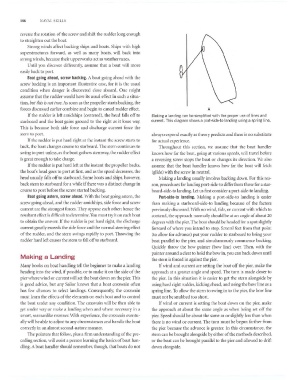
             If the rudder is  left amidships  (centered),  the head falls off to   Making a landing can  be simplified  with  the  proper use of lines and
          starboard  and  the boat gains ground  to the right as it loses  wa)'.   current.  This diagram shows a port·side·to landing using a spring line.
          This  is beci.1llse  both  side  force  and  discharge  current  force  thc
          stern to port.                                         always respond exactly as theory predicts and there is no substitute
             If the rudder is put hard right at the instant the screw starts to   for actual experience.
          back, the boat changes course to starboard. The stern continues to   Throughout  this section, we  assume  that  the  boat  handler
          swing to port unless, as the boat gathers slernway, the rudder effect   knows how far the boat, going at various speeds, will travel before
          is great enollgh to take charge.                       a reversing screw stops the  boat  or changes  its direction.  \\'e also
             If the rudder is put hard left at the instant the propeller backs,   assume  that  the bOilt  handler  knows how  far  the boat  will  fetch
          the boat's head goes to port at first, and as the speed decreases, the   (glide) with the screw in neutral.
          head lIsually falls  off to sti.lrboard. Some boats <1l1d  ships, however,   l\·laking a landing lIsually invol\'es backing dowil.  For this rea·
          back stern to starboard for a while if there was a distinct change in   son, procedures for landing port-side-to dift-er from those for a star·
          course to port before the screw started backing.       board·side-to hlndiJlg. Let us first cOllsider a port·side-to landing.
             Boat going astern, screw ahead. \ Vith the boat going aSlcnl. the   Port-side-lo  landing_ Making  a  pOl't-side-to  landing  is easier
          screw going ahead, and the rudder amidships. side force and screw   than  making  a starboard-side·to  landing  because  of the factors
          cllrrent are the strongest torces. They oppose each other; hence the   previously discussed. \ Vith  no wind, tide, or current with which to
          resultant eftect is difficult to determine. You mllst 11")' it on each boat   contend, the approach normally should be <1t an angle of about 20
          to obtain  the aJls\\'er. If the  rudder is put hard right, the discharge   degrees with the pier. The boat should be headed for a spot slightly
          current greatl), exceeds the side force and the normal steering effect   forward of where you intend to stop. Several feel  from  that  point
          of the  rudder, and the stern  swings  rapidly to port. Throwing the   (to allow for advance) put your rudder to starboard to bring your
          rudder hard left causes the stern to tall off to starboard.   boat  parallel  to  the pier, and simultancously commence backing.
                                                                 Quickly  throw  the  bow  painter  (bow  line) over. Then, with  the
                                                                 painter around a cleat to hold the bow in, you can back down until
          Making a  Landing
                                                                 the stcrn is forced in ag<1inst the pier.
          .Many books on boat handling tell  the beginner to make a landing   If wind and current are setting the boat off the pier, make the
          heading into the wind, if possible, or to  make it all the side of the   approach at a greater angle and speed. The turn  is made closer to
          pier where wind or current will set the boat dowll all the pier. This   the  pier. In  this situation it is easier to get the stern  alongside by
          is  good advice. but any Sailor  knows  that a boat coxswain  often   lIsing hard right rudder, kicking ahead. and using the bow line as a
          has  few  chances  to  select  landings.  Consequently,  the  coxswain   spring line. To allow the stern to swing in  to the pier. the bow line
          must ie<1J'Il  the eft-ects of the elements on each boat and to control   must not be snubbed too short.
          the  boat  under any condition. The coxswain will  be then  able to   If wind or current is setting the boat down on  the pier, make
          get  under wa)' or make a landing when and where necessary in <1   the appronch at abollt the same angle as  when being set off the
          smart, seamnnlike manner.  \Vith experience, the coxswain e\'entu·   pier. Speed should be <1hout the saJl1e as or slightly less than when
          ally will be able to adjust to nny circumstances and handle the boat   there is no wind or Clirrent. The turn must be begun t:trther from
          correctly in an almost second-nature J1lilJ1I1l'r.     the pier because  the advance  is  greater.  In  this circllmstance. the
             The pointers that follow. plus a firm understanding of the pre·   stern Can be brought alongside by either of the methods described.
          ceding section, will assist a person learning the basics of boat han·   or the boat can be brought parallel to the pier and allowed to drift
          dling. A boat handler should remember. though, that boats do llot   down alongside.

