


Page 181 - NAVAL SCIENCE 3 TEXTBOOK
P. 181
HASIC  SEA:-'IA NSI!IP   187

                                                               ably easier  than  maneuvering  a single-screw boat.  You  need  110t
                                                               worry about the separate forces or their combined effect; think of
                                                               it  as  a lever with  a force  (screw) at each  end  and  the load  (boat)
                                                               in  the middle. Thus, rOll  can  readily see  how much  more quickly
                                                               a particular  maneuver may be accomplished  by  using the correct
                                                               propeller combinations along with  the appropriate rudder angle.
                                                               for example,  to  turn your  bo,1t  180 dcgrecs  to  starboard  from  a
                                                               dead stop, use right full  rudder, port enginc <lhe,ld, and starboard
                             •
               Current                                         engine astern. The boat will  make the turn in  little more than its
                                   •
                                                               own  length, whereas a single-screw boat would  require consider-
                                View  1
                                                               ably l110re space  to complete the same turn. It is also  much  easier
                                                               to get into a short berth or other conn ned space with a twin-pro-
                              •                                peller boat .
                                  •
                                                                  Almost  all  the  maneuvers required  of a boat can be  accolll-
                                                               plished by varying the direction and speed of the engines and with-
                                                               out using the rudders. An experienced coxswain also can maintain
                                                               a fair course by varying the number of turns of the propellers.
                    Current
             •
                                View  2
                                                               Boat Etiquette
                                 B
                                                               In  the  Navy  the  observance  of proper  boat  etiquette  is second
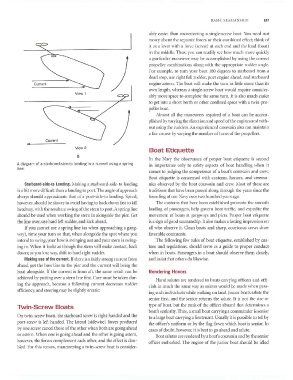
        A diagram of a starboard-side-to landing in a current using a spring   in  importance  only  to  safety  aspects  of boat  handling  when  it
        line.
                                                               comes to judging the competence of ,1  boat's coxswain and crew.
                                                               130at etiquette  is concerned  with  customs,  honors,  ,mel  ceremo-
           Starboard-side-to  Landing. I\'faking a starboard-side-to landing   nies  observed  by the boat coxswain  and  crew.  J\·10st  of these  are
        is a bit morc difl1cutt than a landing to port. The angle of approach   traditions that have been passed along through the years since the
        always should  clpproximatc that  of a port-side-to landing.  Speed,   founding of our Navy over two hundred years ago.
        however, should be slower to avoid having to back down fast to kill   The customs that have been established promote the smooth
        headway. with the resultant swing of the stern to port. A spring line   loading of passengers,  help  govern  boat traffic,  and  expedite the
        should be used when  working the stern in  alongside the pier.  Get   movement of boats at gangways and piers.  Proper boat etiquette
        the line over, use hard left rudder, and kick ahead.   is a sign of good seamanship. It also makes a lasting impression on
           If YOll  C<111110t  use a spring line (as when approaching <l  gang-  all  who  observe it.  Clean  boats  and  sharp, courteollS  crews draw
        way),  time your turn  so  that, when alongside the spot where you   t~l\'orable comments.
        intend to swing, your bow is swinging out and your stern is swing-  The  following  few  rules  of boat etiquette, established by cus-
        ing ill. \,"hen it looks as  though the stern  will  make contact, back   tOIll  and  regulations,  should serve  as  a guide  to  proper conduct
        down; as you lose way, shift to hard right rudder.     when  in  boats.  Passengers in  a boat should  observe them closely,
           Making use of the current. If there is a ti:lirly strong current from   and insist that others do likewise.
        'lhead, get  the bow line to the pier and the current will bring the
        boat alongside.  If the current  is from  aft, the same  result can be   Rendering Honors
        achieved by putting over a stern line first. Care IllUSt be taken dur-
                                                                  Hand salutes  are  rendered to  boats carrying officers and offi-
        ing  the approach,  because  a following current  decreases  rudder
                                                               cials in  much the same way as salutes would be made when pass-
        efficiency, and steering may be slightly erratic
                                                               ing such individuals while walking on land. Junior boats salute the
                                                               senior first, and  the senior returns the salute. 1t  is  not the size  or
        Twin-Screw  Boats                                      type of boat, but the rank of the officer aboard that determines a
                                                               boat's seniority. Thus, a small boat carrying a commill1der is senior
        On twin-screw boats, the st<lrbo<lrd screw is right-handed and the
                                                               to a large boat carrying a lieutenant. Usually it is possible to tell by
        port screw  is  left-handed.  The lateral  (sidewise) forces  produced   the officer's uniform or by the flilg  flown which boat is senior.  In
        by one screw cancel those of the other when both are going ahead   cases of doubt, however, it is best to go ahead and salute.
        or astern. \"'hen one is going ahead and the other is going astern,
                                                                  Boat salutes are rendered bya boat's coxswain and by the senior
        however, the forces complement each other, and the effect is dOLl-
                                                               officer embarked.  The enginE'  of the junior boat should  be  idled
        bled.  For this reason, maneuvering a twin-screw boat is consider-

