


Page 179 - NAVAL SCIENCE 3 TEXTBOOK
P. 179
BAS IC  SEr\~ IANS HIP   185


                          Discharge Current                       A single-screw vessel is IllOst difllcult to maneuver at very low
                                                               speeds where rudder ellect is minimal, while at the same time pro-
                                                               peller sidc force is greatest.
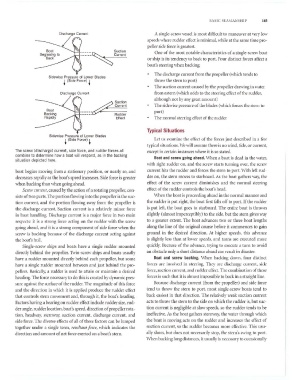
                     Boat          _____ ~ Suction                One of the Illost notable characteristics of a single-screw boat
                  Beginning to     -----         Current
                     Back                                      or ship is its tendency to back to port. Four distinct forces affect a
                                  J                            boat's steering when backing:
                                                                  The discharge current from the propeller (which tends to
                      Sidewise Pressure 01 Lower Blades
                            I (Side Force) I                      throw the stern to port)
                                                                  The suction current caused by the propeller drawing in water
                           Discharge Current                      from astern (which adds to the steering effect of the rudder,
                                                                  although not by any great amount)
                                                 Suction
                                                 Current          The sidewise pressure of the blades (which forces the stern to
                     Boat                                         port)
                    Backing                      Rudder
                    Rapidly                       Effect          The normal steering efiect of the rudder

                                                               Typical Situations
                      Sidewise Pressure of Lower Blades
                            I (Side Force) I                      Let  us examine the efiect of the forces just described  in  il few
                                                               typical situations. \Ve will assume there is no wind, tide, or current,
        The screw (discharge) current,  side force,  and  rudder forces all   except in certain instances where it is so stated.
        combine to determine how a boat will respond,  as  in  the backing   Boat and  screw going ahead. \Vhen a boat is dead in the water,
        situation depicted  here.
                                                               with right  rudder on, and  the screw stttrts turning over, the screw
        boat begins moving from  a stationary position, or nearly so, and   current hits the rudder and forces  the stern to port. \'''ith left rud-
        decreases rapidly as the boat's speed increases. Side lorce is greater   der Oil, the stern  moves to starboard. As  the boat gathers way, the
        when backing than when going ahead.                    effect  of the  screw  current  diminishes  and  the  normal  steering
                                                               effect of the rudder controls the boat's head.
           Screw cmTCIII, c;:lused by the action of a rotating propeller, COIl-
        sists of two parts. The portion Oowing into the propeller is the suc-  \  " hen the boat is proceeding ahead in the nonnttl manner and
        tion current. and the portion  Oowing away  from  the propeller is   the rudder is put right, the boat first tiliis off to port. If the rudder
        the discharge current.  Suction current is a relatively  minor force   is  put left, the boat gocs  to  stttrboard. The entire boat  is  thrown
        in boat handling. Discharge Cl11'rent is a major force  in two  main   slightly (almost imperceptibly)  to the side, but the stern gives way
        respects:  it  is a strong force  acting on  the rudder with  the screw   to  tt  greater extent. The boat advances  two  or three boat lengths
        going ahead, and it  is a strong component of side  force  when  the   along the line of the original course before it  commences  to gain
        screw  is backing  because of the discharge current acting  against   ground  in  the  desired  direction.  At  higher  speeds,  this  advance
        the boat's hull.                                       is slightly less  than at lower speeds, and turns are executed  more
           Single-screw  ships and  boats  ha\'e  a single  rudder  mounted   quickly. Because of the advance, trying to execute a turn to avoid
        directly behind the propeller. Twin-screw ships and boats usually   an obstacle only a short distance ahead call result in disaster.
        have a rudder mounted directly behind each  propeller, but some   Boat  and  screw  backing.  ' ·"hen  backing down, lolll'  distinct
        have a single  rudder mounted  between and just behind  the  pro-  forces  are  involved  ill  steering.  The),  are  discharge  current, side
        pellers.  ilasically,  a rudder is used  to  attain  or maintain a desired   to rce, sllction current, and rudder effect. The combination of these
        heading. The force necessary to do this is created by dynamic pres-  forces is sllch that it is almost impossible to back in a straight line.
        sure against the surface of the rudder. The magnitude of this force   ilecause discharge current (from  the propeller) and side force
        and the direction  in  which  it  is applied produce the rudder effect   tend  to  throw the stern  to  port, most single-screw bonts  tend  to
        that controls stern movement and, through  it, the boat's headi ng.   back easiest in  that direction. The relatively weak suction current
        Factors having a bearing on rudder effect include rudder size, rud-  acts to throw the stern to the side all which the rudder is, but suc-
        der angle, rudder location, boat's speed, direction of propeller rota-  tion cllrren t is negligible <11 slow speeds, so the rudder tends to be
        tion,  headway,  sternway, suction  current, discharge  current, and   ineftectivc. As  the boat gathers sternway, the water through which
        side force. The diverse effects of all of these factors can be lumped   the boat is moving acts on the  rudder and  increases the efiect of
        together  LInder  a single  term, resllitnllt force,  which  indicates  thc   suction current, so  the  rudder becomes 1110re effective. This usu-
        direction and amount of net force exerted on a boal's stern.   ally slows, but does not  necessarily stop, the stern's swing to port.
                                                               \," hen backing long distances, it usually is neccssaq' to occasionally

