


Page 178 - NAVAL SCIENCE 3 TEXTBOOK
P. 178
184     NAVAL  SKILLS


                                                                Propeller Forces
                                                                   Generally speaking,  a boat  is  moved  by  forces resulting from
                                                                pressure diiTerences. For all practical purposes, water is incompress-
                                                                ible;  therefore, when  a propeller or screw rotates,  high- and  low-
                                                                pressure areas ,ll'e created on opposite sides of the propeller blades.
                                                                This  force, called propeller  (111'1/5( ,  is  transmitted along the  propel-
                                                                ler shaft ti·om the high-pressure area toward the low-pressure area.
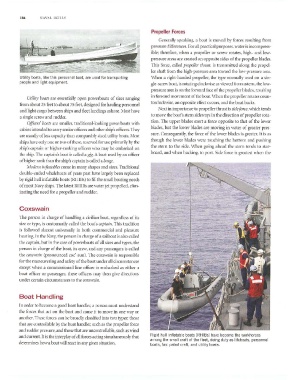
         Utility boats,  like this personnel  boat,  are used  for transporting   \Vhen  a right-handed propeller, the  type  normally used  on a sin-
         people and  light equipment.                           gle-screw boat, is rotating clockwise as viewed from astern, the low-
                                                                pressure area is on the forward face of the propeller blades, resulting
            Utility boats are essentially open  powerboats of sizes  ranging   in forward movement of the boat. \Vhen the propeller rotntes COUI1-
                                                                terclock'wise, an opposite effect occurs, and the boat backs.
         from about 25 feet to about 75 feet, designed lor hauling personnel
                                                                   Next in importance to propeller thrust is side force, which tends
         and light cargo between ships and fleet landings ashore.1\'Iost have
                                                                to move the boat's stern sideways in the direction of propeller rota-
         a single screw and rudder.
                                                                tion. The upper blades exert a force opposite to  that of the lower
            OJJicers' boa($  arc  smaller, traditional-looking powerboats with
                                                                blades, but the lower blades are  moving in  water of greater pres-
         cabins intended to carry senior officers and other ship's officers. They
                                                                sure. Consequently, the force of the lower blcldes is greater. It is as
         ,He usually of less capacity than comparably sized utility boats. Most
                                                                though  the  lower  blades were  touching the  bottom  and  pushing
         ships have only one or two of these, reserved for lise primarily by the
                                                                the stern  to  the  side.  \Vhen  going ahead  the  stern  tends to  star-
         ship's captnin or higher-ranking officers who mily be embarked on
                                                                board, and when  backing, to port. Side force  is  greatest when the
         the ship. The captain's boat is  c<llled a gig. A boat used by an officer
         of higher rank than the ship's captaill is called a uarge.
            IHodel'll iI/fi(/tables come in many shapes nnd sizes. Traditional
         double-ended whaleboats of years past have largely been  replaced
         by rigid hull intlatable boats (RHIBsJ to fill the small boating needs
         of most Navy ships. The latest RHIRs are water jet propelled, elim-
         inating the need for a propeller and rudder.


         Coxswain
         The person  in  charge of handling a civili,m bont, regardless of its
         size or type, is cllstomarily called the boat's mptnill. This tradition
         is  followed  almost  universally  in  both  commercial  and  pleasure
         boating. In the N,wy, the person in charge of a sailboat is also called
         the captain, but in the case of powerboats of all sizes and types, the
         person in charge of the boat, its crew, and any pnssengers is called
         the coxslI'ain  (pronounced coc'-sun). The coxswnin is  responsible
         for the maneuvering and sa let)' of the boat under all circulllstances
         except when  a commissioned line officer  is  embarked as  either a
         boat officer or passenger;  these  officers  may then  give  directions
         under certain circumstances to the coxswain.


         Boat Handling
         In order to become a good boat handler, a person must understnnd
         the forces  that act  on  the boat and cause it  to move in one wny or
         another. These forces can  be broad I)' classified into two types: those
         that are controllable by the boat handler, such as the propeller force
         and rudder pressure, and those that are uncontrollable, such as wind
         and current. It is the interplay of <.111  forces acting simultaneollsly that   Rigid  hull  inflatable boats (RH IBs)  have  become the  workhorses
                                                                among the small craft of the fleet,  doing duty as  lifeboats,  personnel
         determines how a boat will react in any given situatiol1.
                                                                boats,  fast  patrol  craft,  and  utility boats.

