


Page 204 - NAVAL SCIENCE 3 TEXTBOOK
P. 204
210     NAVAL  SKILLS


         solar time at any moment is  called the equation of time,  It is  tab-  Zone time.  Zone time (ZT) = standard time. Since local  mean
         ulated  in  navigational publications called almanacs,  and must be   time is based on the relationship between one's own meridian and
         taken into account for certain tasks in celestial navigation at sea,   the mean Sun, a slight difference in longitude between two places
            Atomic time. Besides the above kinds of time that are based on   would result in a slight difference in time kept. Though not very
         the relationship of the Earth and the Sun, there is one other more   significant in days of old, this difference would be very impractical
         modern base for time that is coming into ever wider use because   in our modern world. For exarnple, if we set our watches to local
         of its extreme accuracy, This is atomic time, called universal coor-  mean time (LMT), we would have to reset them every few blocks
         dillated  time, abbreviated as  UTe. This time is  based on the fre-  along an east-west street. In New York City, for instance, a difter-
         quency  of vibrations  of the  radioactive  cesium  atom.  Because   ence of about nine seconds LMT occurs between one end of 42nd
         cesium  is  a  fairly  common  element, it  is  readily available  to  be   Street and the other end.
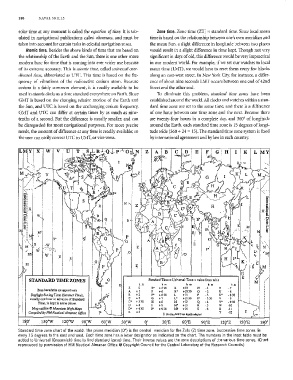
         used in atomic clocks as a time standard everywhere on Earth. Since   To  eliminate  this  problem,  standard  time  zones  have  been
         GMT is based on the changing relative motion of the Earth  and   established around the world. All clocks and watches within a stan-
         the Sun, and UTe is based on the unchanging cesium frequency,   dard time zone are set to the same time, and there is a difference
         GJ\'fT  and  UTe can  difter at certain  times  by as  much as  nine-  of one hour between one time zone and the next. Because there
                                                                                                       0
         tenths of a second.  But the difterence is  usually smaller, and can   are  twenty-four hours in a complete day,  and 360 of longitude
         be disregarded for  most navigational purposes.  For more precise   around the Earth, each standard time zone is  15 degrees of longi-
         needs, the amount of difference at any time is readily available; so   tude wide (360 + 24 = IS). The standard time zone system is fixed
         the user can easily correct UTC to GMT, or vice versa,   by international agreement and by law in each country.

         LI\1i Y  X  W  V  U                                              c,n  E               H  I    K  L     ,y
                                                                          ~''''''Ii'-V
                                                                                                                '.

          M


                       Y'
                    :\V
                   •  '.'  >.
                                                                                                               I
                    W'    u   s
            M
                                                                                                               M

             STANDARD TIME ZONES                                                                           M
                                                   0       h  m      h  m      h  m     h  m      h m
                                                       Z   0    E'   +530   K   +10   N   -1   T   ·7
                 Zone boundaries are appro:dmate          +1
                                                       A        F   +6    K'   +1030   P  .,   U   -8
                                                                                    0
                                                                                       -2
              Daylight Saving Time (Summer Time),      B   +2   F'   +630   L   +l!          U'   - 8 30
              usually one hour in advance of Standard   C   +,   0   +7   L'   +11  30   P'   ·330   Y   -9
                 Time, is kept in some places          C'   + 3 30   H   +8   M   +12   Q   ·4   Y'   -930
                                                       D   +4   1   +9    M'   +13   R   ·5   W   -10
               Map outline © Mountain High Maps        D'   +430   I'   + 9 30   Mt   +14   S   ·6   X   -l!
             Compiled by HM Nautical Almanac Office    E   +5        t  No S!a.Ildard Time legally &dopt«!   y   -12   I
           180'    150'W   120'W   90'W     60'W    30'W      0'     30'E    60'E    90'E    12  'E   150'E   180'
         Standard time zone chart of the world,  The  prime meridian  (00)  is the centra!  meridian for the Zulu  (Z) time zone.  Successive time zones  lie
         every 15 degrees to the east and west.  Each time zone has a letter designator as  indicated on the chart. The numbers in  the  inset table  must  be
         added to  Universal  (Greenwich) time to find standard (zone) time. Their inverse values are the zone descriptions of the various time zones,  (Chart
         reproduced  by permission of  HM  Nautical Almanac Office @  Copyright Council  for the Central  Laboratory of the  Research  Councils)

