


Page 234 - NAVAL SCIENCE 3 TEXTBOOK
P. 234
II Naval Aircraft and Missiles


         In  this  ch<lptcr  we  will  take  a brief look  at  naval aircraft,  their   Fighters arc high-performance aircraft lIsed to gain air superi-
         weapon systems, and guided missiles used in the U.S. Nay}'.   ority. They may be used defensively as interceptors, offensively
            Naval  clircraft.  like  aircraft  in  general,  fnll  into  three  mam   as escorts for bombers, or on ground suppor!  missions. Some
         groups:  fLxcd-wing.  rotary-wing. and lighter-than-air.  Fixer/-willg   can carry bombs Hnd other precision weapons for limited
         airplanes have wings that are the primary lifting devices of the air-  attack missions.
         plane. Rotary-wil1g craft, primarily helicopters. have two or morc   Patrol aircrafrare land-based, long-range llluitiengine planes
         rotor blades that lift  the ilircraft into the air.  /.ighter-fha/Hlir craft,   llsed mainly for antisubmarine patrol. They can detect, locate,
         such  as blimps, depend  on casings filled  with  light gas,  primarily   and destroy submarines. They·can also escort surface COI1\,oys,
         helium. to provide their lifting power.                   conduct photographic missions, and lay mines from  the air.
            Fixed-wing aircraft have many roles in the Nav)':
                                                                   Electro/lie lI'm/are (El \') aircraft detect and jam enCI11}' radars
            Attack plnnes <"Ire  lIsed for low-level bombing, ground Slipport,   to protect the strike group (attack and support aircraft) from
            or nuclear strikes. They carry heavy payloads (fuel, bombs,   being targeted by enemy missiles. guns, or interceptor aircraft.
            and missiles) and Glil remain on station long enollgh to sup-  Rec01llw;ssallce aircraft are aircraft that have been speciilll}'
            port ground troops.                                    configured to gather intelligence.


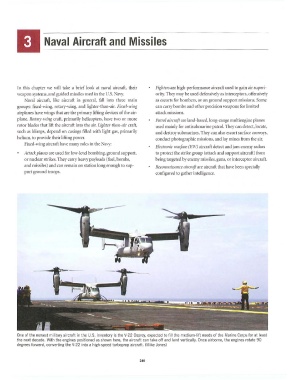
         One of the  newest military aircraft in the  U.S.  inventory is the V-22 Osprey,  expected  to  fill  the medium-lift needs of the Marine Corps for at  least
         the next decade.  With  the engines positioned as shown  here, the aircraft can take off and  land vertically. Once airborne, the engines rotate 90
         degrees forward, converting the V-22 into a high-speed turboprop aircraft. (Mike Jones)


                                                            240

