


Page 236 - NAVAL SCIENCE 3 TEXTBOOK
P. 236
242     NAVAl.  SKILLS

         c\'CI1  though  it is se\'cn1l models later than the original design. the   Homil/gguirinllccdepends 011  the missile picking up and track-
         RJ.\ 1-66 Standard  I missile. phased out of u .S. service in 2003.   ing n target b)I means of radar, optical. or heat-seeking devices. The
                                                                homing system  will  follow an}' evasive  maneU\'ers  nttempted  by
                                                                the target. and  the missile is  l~lSt enough to overtake most targets
         Missile Components                                     trying to outrun  it.  There arc several types of homing guidance.
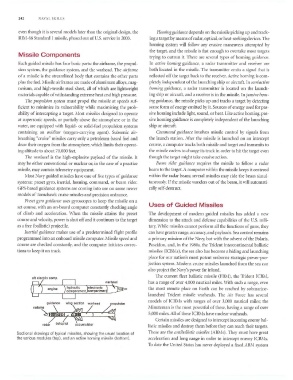
         Each guided missile has fOllr basic parts:  the airframe. tile propul-  In  (Ictil'c hOlllillg  guidance,  a  mdnr  transmitter  illld  recei\'er  are
         sion system. the guidance system, and the warhead. The (Ii1/mllll!   both located  in  the  missile.  The transmitter emits a signal  that  is
         of a missile  is the streamlined body that contains the other parts   reflected off the target back to the receiver. Active homing is COIll-
         plus the fuel.  ~vlissile airframes ilre made of aluminum altoys, Il1ng-  pletely independent of the launching ship or aircraft. In sCl1Iinctil'c
         nesiulll, and  high-tensile steel  sheet, all  of which are  lightweight   hOl1lillg guidancc, i1  radar  tr<1l1smitteJ'  is  located  0 11  the lauIlch-
         materials capnble of withstilllding e:\1reme heat and high pressure.   ing ship or aircraft, and a receiver is in  the missile. In pl15sil e 110111-
                                                                                                            '
            The proplllsion system  must propel  the  missiJe  at speeds  suf-  illg guidance, the missile picks up and  tmcks n target b}1 detecting
         ficient  to  minimize  its vulnerability while maximizing the  prob-  some form of energy emitted by it. Sources of energy used for pas-
         ilbilit)' of intercepting a target.  Most missiles designed  to  operate   sive homing include light, sound, or heat. Like active homing, pas-
         at supersonic speeds, or partially above  the atmosphere or in  the   sivc homing guidance is completely independent of the launching
         water, are equipped with  Iiquid- or solid-fuel propulsion systems   ship or aircraft.
         containing  an  oxidizer  (oxygen-carrying  agent).  Subsonic  nir-  COllll1l(l/ld gllidnllce  involves  missile  control  by signals  from
         breathing "cruise" missiles carry only a petroleum-based fuel  and   the launch station.  After the missile is Imlllched  on an intercept
         draw their oxygen from the atmosphere. which limits their operat-  course, a computer tracks both missile and target and transmits to
         ing altitude to about 70.000 feet.                    the missile orders to change its track in order to hit the target even
            'J7Je  w(I/'head  is the high-explosi\'e  payload  of the missile.  It   though the target might take evasive nctiol1.
         Illny be either conventional or nuclear or, in  the case of a practice   Beam  ,.ider gllidm/ce  requires  the  missile  to  follow  a  radnr
         missile, may colltnin telemetry equipment.            beam to the target. A computer within the missile keeps it centered
            Most Navy guided  missiles ha\'e one of fi\'e types of guidance   within  the radar bcam; several  missiles  mil)' ride the beam simul-
        systems:  preset  gyro,  inertial, homing,  cOlllmand,  or beam  rider.   taneously.  If the missile wanders out of the benlll, it will i1utomati-
        GPS-based guidance systems are coming into use on some newer   call)' selt~destruct.
         models ofTomailawk cruise missiles and precision ordnill1ce.
           Preset gyro gllidal/ce  uses gyroscopes to  keep the  missile all a
                                                               Uses of Guided Missiles
        set course, with an on-bonrd computer constilntly checking angle
        of climb  and  accelemtion.  \Vhen  the  missile  attains  the  preset   The development  of  Illodern  guided  missiles  hilS added  a  new
        comse and vclocity, power is shut off and it continues to the target   dimension to  the attack  and defense cnp<tbilities of the U.S.  mili-
        as a free (ballistic) projectile.                      till')'. \Vhile missiles cannot perform all  thc functions of guns, they
           Inertial guid(ll/ce  makes use  of a predetermined flight  profile   can have greater range. accuracy, ilnd pilyloads. Sen control remains
        programmed into nn onboard missile computer. ~'I'lissile speed and   ;:1  primary mission of the Navy. but with  the nd\'ent of the Polaris,
        course nre checked constantly, and  the computer initiates correc-  Poseidon, and, in  the  1980s,  the 'n'ident intercontinenl<ti  ballistic
        tions to keep it on track.                             missiles (ICln.'is), the sea also has become n hiding ilnd launching
                                                               place for  our nation's  IllOSt potent seaborne stmtegic power-pro-
                                                               jection system. ?\·fodern cruise missiles  launched from  the sea can
                                                               also project the Navy's power tar inlnnd.
                                                                  The  current fteet  ballistic missile (FIlM).  the Trident  ICBM.
                                                               has il mnge of over 4,000 nautical milcs. \ "ith such  a range. even
                                                               the  most  remote  place  on  Earth  can  be  reached  by submarine-
                                                               launched  Trident  missile  wnrheads.  The  Air  Force  has  several
                                                               models of iCBJ\·is with  mnges  of over  3,000  Ilautical  miles;  the
               .. dome  g=-~ w:;pn Jhe'd ,G",on                Milluteman is the most powerful of these, having il range of over
                  ~7~ ~  ~                                     5,000 miles. All of these ICBMs hnve I1llele-nl' wi.lI'heads.


                   radar   autopilot   accumulator                Cert;:lin missiles are designed to intercept incoming enemy bal-
                                                               listic missiles and destroy thcm before they Cim reach their targets.
        Sectional  drawings of typical missiles, showing the usual  location of   These  are  the (lIllibnllistic  llIissiles  (ARMs).  Thcy must have  great
        the various  modules (top),  and an  active homing missile (bottom).   acceleration  and long range  in  order to  intercept  enemy  ICBMs.
                                                               To date the United States has never deplo)'ed a fixed  ABM  s),stem

