


Page 53 - NAVAL SCIENCE 3 TEXTBOOK
P. 53
58      NAVA L  KNOWLEDGE


                                                                                             J
                                                   Department of  Defense (DOD)
                                                                             I             I
                                  Defense  Intelligence Agency (DIA)   I   National      National
                                        I           I         I          Imagery and     Security
                                                                          Mapping
                                                                           Agency        Agency
                          Ar my      OHice of   Air Force   Marine Corps
                        Intell  Igence   Naval   Intelligence   I ntell  igence
                         Com mand   Intelligence   Command
                                                                                  Defense
                                                                                 Investigative
                                                                                  Service
                               Defense             National
                               Attache          Reconnaissance
                               System                                        I               I
                                                                        Naval  Criminal   Air Force  & Army
                                                                         Investigative   Investigative
                                                                          Service          Services


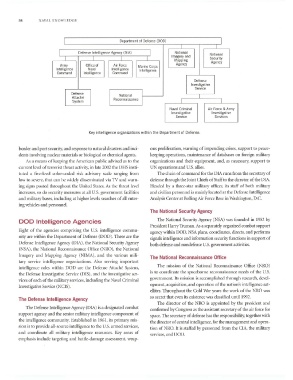
                                      Key  intelligence organizations within the  Department of Defense.


         border and port security, and response to natural disasters and inci-  ons proliferation, warning of impending crises, support to  peace-
         dents involving nuclear materials or biological or chemical agents.   keeping operations, maintenance of databases on foreign military
            As a means of keeping the American public advised as to the   organizations and their equipment, and, as  necessary, support to
         current level of terrorist threat activity, in late 2002 the DHS insti-  UN operations and US. allies.
         tuted  a  five-level  color-coded  risk  advisory  scale  ranging  from   The chain of command for the DIA runs from the secretary of
         low to severe, that can  be widely disseminated via TV and warn-  defense through the Joint Chiefs of Staff to the director of the DIA.
         ing signs posted throughout the United States. As  the threat level   Headed  by  a  three-star military officer,  its  staff of both military
         increases, so do security measures at all  U.S. government facilities   and civilian personnel is mainly located at the Defense Intelligence
         and military bases, including at higher levels searches of all enter-  Analysis Center at Bolling Air Force Base in Washington, D.C.
         ing vehicles and personnel.
                                                                The  National  Security Agency

                                                                   The National Security Agency  (NSA)  was  fowlded in  1952 by
         DOD Intelligence Agencies
                                                                President Harry Truman. As a separately organized combat support
         Eight  of the  agencies  comprising  the  US.  intelligence  commu-  agency within DOD, NSA plans, coordinates, directs, and performs
         nity are within the Department of Defense (DOD). These are the   signals intelligence and information security functions in support of
         Defense Intelligence Agency (DIA), the National Security Agency   both defense and nondefense US. government activities.
         (NSA),  the National Reconnaissance Office  (NRO), the National
         Imagery  and  Mapping  Agency  (NINIA),  and  the  various  mili-
                                                                The National  Reconnaissance Office
         tary  service  intelligence  organizations.  Also  serving  important
                                                                   The  mission  of the  National  Reconnaissance  Office  (NRO)
         intelligence  roles  within  DOD  are  the  Defense  Attache  System,
                                                                is  to  coordinate the spaceborne reconnaissance needs of the US.
         the Defense Investigative Service (DIS), and the investigative ser-
                                                                government. Its mission is accomplished through research, devel-
         vices of each of the military services, including the Naval Criminal
                                                                opment, acquisition, and operation of the nation's intelligence sat-
         Investigative Service (NCIS).
                                                                ellites. Throughout the Cold War years the work of the NRO was
                                                                so secret that even its existence was classified until 1992.
         The  Defense  Intelligence Agency
                                                                   The director of the  NRO  is  appointed by the president and
            The Defense Intelligence Agency (DIA) is a designated combat
                                                                confirmed by Congress as the assistant secretary of the air force for
         support agency and the senior military intelligence component of   space. The secretary of defense has the responsibility, together with
         the intelligence community. Established in  1961, its primary mis-  the director of central intelligence, for the management and opera-
         sion is to provide all-source intelligence to the US. armed services,   tion of NRO. It is staffed by personnel from the CIA, the military
         and  coordinate  all  military  intelligence  resources.  Key  areas  of   services, and DOD.
         emphasis include targeting and battle-damage assessment, weap-

