


Page 51 - NAVAL SCIENCE 3 TEXTBOOK
P. 51
56      N AVAL  KN OWLEDGE


            Dissemination. The last step in the cycle, which logically   During the 1960s and 1970s, special secret high-speed jet air-
            feeds into the first, is the distribution of the finished intel-  craft  such  as  the  U-2  and  SR-71  Blackbird  were  developed  that
            ligence to the consumers whose needs initiated the process.   could fly  above the ceilings of most defensive weapons and pho-
            Typicalli, dissemination is accomplished by means of various   tograph  wide  bands  of the  surface  with  special  high-resolution
            distribution lists, each made up on a "need to know" basis.   cameras. When  these "spy planes" returned  from  their  missions,
            Intelligence may be disseminated by oral briefings, messages   air intelligence officers could examine the resulting film and learn
            or written reports, published studies, and photographs and   a  great deal about such  things  as  enemy fortifications,  bombing
            other media. The continuous flow of accurate, timely naval   damage to  enemy facilities,  troop dispositions, and  the like.  This
            intelligence is essential to planning successful naval opera-  type of intelligence was extensively used during the Vietnam War
            tions. Good intelligence, properly used by commanders, has   and many of the other conflicts involving U.S. forces since then.
            saved thousands oflives and won many battles.


         Types of Intelligence

         Intelligence may be classified  according to source, such as signals
         (SIGINT),  communications  (COMINT),  electronics  (ELINT),
         photo (PHOTINT), and human  intelligence (HUMINT). It may
         also be described by the area to which it pertains:
            Naval intelligence is concerned mainly with collecting infor-
            mation of interest to the Navy. It includes information about
            foreign (both friendly and unfriendly) ships, weapon sys-
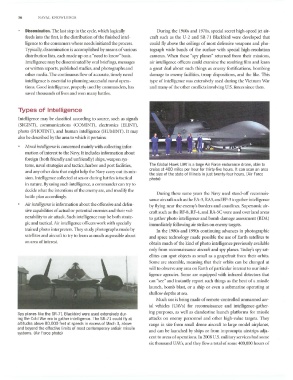
            tems, naval strategies and tactics, harbor and port facilities,   The Global  Hawk UAV  is a large Air Force endurance drone, able to
                                                                cruise at 400 miles per hour for thirty-five hours.  It can  scan  an  area
            and any other data that might help the Navy carry out its mis-
                                                                the size of the state of  Illinois in  just twenty-four hours.  (Air Force
            sion. Intelligence collected at sea or during battles is tactical   photo)
            in nature. By using such intelligence, a commander can try to
            decide what the intentions of the enemy are, and modify the
                                                                   During these same years the Navy  used stand-off reconnais-
            battle plan accordingly.
                                                                sance aircraft such as the EA-3, RA3, and EP-3 to gather intelligence
            Air intelligence is information about the offensive and defen-  by flying near the enemy's borders and coastlines. Supersonic air-
            sive capabilities of actual or potential enemies and their vul-  craft such as the RF-8, RF-4, and RA-5C were used over land areas
            nerability to air attack. Such intelligence may be both strate-  to gather photo intelligence and bomb damage assessment (BDA)
            gic and tactical. Air intelligence officers work with specially   inlmediately following air strikes on enemy targets.
            trained photo interpreters. They study photographs made by   In  the  1980s and 1990s continuing advances in  photographic
            satellites and aircraft to try to learn as much as possible about   and space technology made possible the use of Earth satellites to
            an area of interest.                                obtain much of the kind of photo intelligence previously available
                                                                only from  reconnaissance aircraft and spy planes. Today's spy sat-
                                                                ellites  can spot objects as  small as  a grapefruit from  their orbits.
                                                                Some are  steerable,  meaning that their  orbits can  be changed at
                                                                will to observe any area on Earth of particular interest to our intel-
                                                                ligence agencies. Some are equipped with  infrared detectors  that
                                                                can "see" and instantly report such things as  the heat of a missile
                                                               launch, bomb blast, or a ship  or even  a submarine operating at
                                                                shallow depths at sea.
                                                                  Much use is being made of remote-controlled unmanned aer-
                                                                ial  vehicles  (UAYs)  for  reconnaissance  and  intelligence-gather-
                                                                ing purposes, as  well  as  clandestine launch  platforms for  missile
         Spy planes like the SR-71  Blackbird were  used  extensively dur-
         ing the Cold  War era to gather intelligence. The  SR-71  cou ld fly at   attacks  on  enemy personnel  and  other  high-value  targets.  They
         altitudes above 80,000 feet at speeds in  excess of Mach 3, above   range  in  size  from  small  drone aircraft  to  large  model  airplanes,
         and  beyond  the effective limits of most contemporary antiair missile
         systems.  (Air Force photo)                           and can  be launched by ships or from  impromptu airstrips adja-
                                                               cent to areas of operations. In 2008 U.S. military services had some
                                                               SL,( thousand UAYs, and they flew a total of some 400,000 hours of

