


Page 100 - NS-2 Textbook
P. 100
WORLD WAR II:  THE ATLANTIC WAR                                                                        93


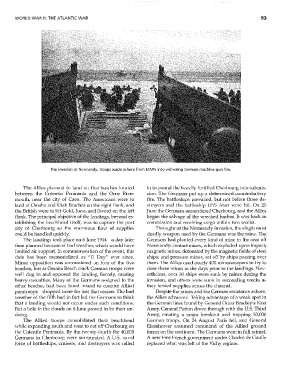
                      The  invasion at Normandy. Troops wade ashore from  lCVPs into withering German  machine-gun fire.


           The Allies planned to land on five  beaches located   in to pound the heavily fortified Cherbourg into submis-
       between  the  Cotentin  Peninsula  and  the  Orne  River   sion. The Germans put up a determined cOlmterbattery
       mouth,  near  the  city  of  Caen.  The  Americans  ·were  to   fire.  The battleships prevailed, but not before  three de-
       land at Omaha and Utah Beaches on the right flank, and   stroyers  and  the  battleship  USS  Texas  were  hit.  On 25
       the British were to hit Gold, jlmo, and Sword on the left   jlme the Germans surrendered Cherbourg, and the Allies
       flank. The principal objective of the landings, beyond es-  began the salvage of the wrecked harbor. It was back in
       tablishing the beachhead itself, was to caphlre the port   corrunission and receiving cargo vvithin hvo V\reeks.
       city  of  Cherbourg  so  the  enormous  flow  of  supplies   Throughout the Nonnandy invasion, the single most
       could be handled quickly.                               deadly weapon used by the Germans was the mine. The
           The landings took place on 6 june 1944--a day later   Germans had planted every kind of mine in the seas off
       than planned because of bad weather, which would have   Normandy: contact mines, which exploded upon impact;
       limited air support. In commen10ration of the event} this   magnetic mines, detonated by the magnetic fields of steel
       date  has  been  memorialized  as  "D  Day"  ever  since.   ships; and pressure mines, set off by ships passing over
       IvIinor  opposition  was  encountered  on four  of the  five   them. The Allies used nearly 400 minesweepers to try to
       beaches, but at Omaha Beach crack German troops were   clear these mines in the days prior to the landings. Nev-
       well  dug in and opposed the landing  fiercely,  causing   ertheless, over 30 ships were Slmk by mines during the
       heavy casualties. Many of the Germans assigned to the   invasion, and others ,veTe slmk in  succeeding V\Teeks  as
       other beaches had been I ured  inland to COlmter  Allied   the)' ferried supplies across the chaImel.
       paratroops-dropped there for just that reason. The bad     Despite the mines and the Gennan resistance ashore,
       weather of the fifth had in fact led the Germans to think   the Allies advanced. Taking advantage of a weak spot in
       that a landing "\vould  not occur  under such conditions.   the German lines fOlU1d by General Omar Bradley's First
       But a hole in the clouds on 6 ltme proved to be their lU1-  Army, General Patton drove through with the U.s. Third
       doing.                                                 Army,  creating  a  major  breakout  and  trapping  50,000
           The  Allied  troops  consolidated  their  beachhead   German  troops.  On 24  August Paris  fell,  and  General
       while expanding south and west to cut off Cherbourg on   Eisenhower  assumed  command  of  the  Allied  grOlmd
       the Cotentin Peninsula. By the hventy-fourth the 40,000   forces on the continent. The Germans 'were in full retreat.
       Germans in Cherbourg  were  surrOlmded. A U.S.  naval   A He\V Free French goverrunent lmder Charles de Gaulle
       force  of battleships, cruisers,  and  destroyers "vas called   replaced what was left of the Vichy regime.

