


Page 98 - NS-2 Textbook
P. 98
WORLD WAR II: THE  ATLANTIC WAR                                                                       91


       probably  have  made  the  difference.  On 16  September   pounded the enclosed Allies.  A major seaborne supply
       Montgomery's Eighth Army joined  forces  with Clark's   route  was  established between Anzio  and  Naples  over
       Fifth Army, and the Gernlans 'withdrew to a ne"w defense   the next several months. As forces on both sides grew, Al-
       line north of Naples. That great port city was occupied   lied casualties rose  to  59,000  luen.  One-third 'were  lost
       by the Fifth Army on 1 October. 111e port was a shambles,   frolll  disease,  exhaustion,  and  stress  caused  by  severe
       and  the  harbor  was  cluttered  with  sunken,  booby-  battle fatigue and continuous rains.
       trapped ships scuttled by the Germans. Clearance of the   The Allied force  eventually grew to  90,200 Ameri-
       harbor was assigned to the Seabees, who managed to do   cans and 35,500 British, packed into a small beachhead.
       it,  despite  incredible  obstacles,  within  four  months.   111ey  were  surrounded  by  135,000  Germans  who  had
       Meanwhile,  the Allies  began  their buildup  for  further   placed their artillery so it could reach any part of the in-
       movement north\vard.                                   vasion site. It \vasn't lmtil  the rains ceased in May that
                                                              the  Allies  finally  broke  the  German  hold  on  Monte
                                                              Cassino, the key fortress on the Gustav Line, and sUl'ged
                            ANZIO
                                                              northward. 111e  Germans broke off all contact at Anzio
       The Germans had consolidated their forces at the Gustav   when this happened, and the victorious Allies swept un-
       Line, about halfway between Naples and Rome. To  by-   opposed into Rome on 4 June.
       pass these defenses, the Allies planned an "end run"-an   Two days later the focus  of attention in Europe be-
       amphibious assault on Anzio Beach, some 37 miles south   came coastal France, where the great cross-Charmel op-
       of Rome. The plam1ing was complicated by the fact that   eration against Hitler's Festul1g Europa  (Fortress Europe)
       many of the Allied  forces  in the Mediterranean theater   began.  111e  rest  of  the  Italian  campaign  received  little
       were being transferred to England in preparation for the   public attention.  Nevertheless, the fighting went on, as
       great invasion of France across the English Charmel.   the Germans slowly but steadily retreated northward.
          Nevertheless, the landing  was made  on 22 January
       1944 with only hvo reinforced divisions. 111e initial land-
                                                                          OPERATION  OVERLORD:
       ing met with little resistance, but the Germans quickly
                                                                         INVASION OF NORMANDY
       moved in to  stop any forward  movement by  the  rela-
       tively small Allied invasion force. Allied reinforcements   Hitler had calculated that the Allies would be invading
       poured into the small area, but the Germar1s kept rein-  his Feshmg Europa no later than the spring of 1944. He
       forcing their stmounding forces  at a similar rate, build-  ordered the commander on the western front, Field Mar-
       ing  up  powerful  artillery  defenses  that  continuously   shal Karl von Rundstedt, aI1d his deputy, Field Marshal
                                                              Rommel, to build a great "Atlar1tic Wall" of concrete for-
                                                              tifications to keep the Allies out. Von Rundstedt felt that
                                                              static defenses 1Nere useless against naval gunfire, so he
                                                              organized highly mobile inland divisions, which could
                                                              rush to any spot where an invasion occurred.
                                                                 Rommel, on the other hand, felt that Allied air power
                                                              would prevent the mobile divisions from getting to  the
                                                              seacoast.  So  he  concentrated  his  efforts  on  beach  de-
                                                              fenses,  counting  heavily  on  mines.  He  also  had  con-
                                                              cluded that the Allies probably would invade at the Nor-
                                                              mandy  beaches,  rather  than  at  Calais,  the  English
                                                              Charme]'s narrowest point. He was right. The Allies had
                                                              begun to prepare for a major amphibious invasion of the
                                                              Normandy coast,  about  170  miles  southwest of Calais,
                                                              tmder the code name Operation Overlord.
                                                                 In the early spring Eiseul10wer began a strategic air
                                                              attack  against  Germany  designed  to  eliminate  aircraft
                                                              factories ar1d ruin the Lufh"affe. By April the raids had
                                                              decimated the Germar1 air force  to  the point where the
                                                              Allies could count on a thirty-to-one superiority over the
                                                              Normandy beaches. Next, the Allied air forces struck at
                                                              the  railroad  marshaling  yards,  bridges,  and  the  trains
                                                              and tracks  thelllselves, '\vreaking such havoc that it was
                                                              almost impossible for any military traffic to move by rail
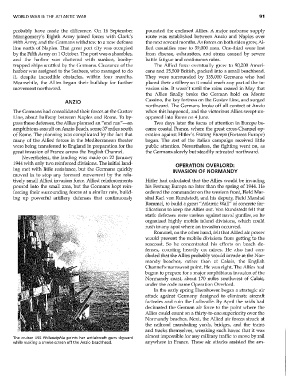
      The  cruiser  USS  Philadelphia  points  her  antiaircraft  guns  skyward
      while making a smoke screen off the Anzio beachhead.    anywhere in France. 111ese  air attacks  assisted  the  am-

