


Page 99 - NS-2 Textbook
P. 99
92                                                                                       MARITIME  HISTORY


         phibious assault. In fact,  the Allied air strikes in France   initial landings, so the landing craft could unload and re-
         and Germany IIad to be successful if Operation Overlord   tract without becoming stranded. At the same time,  the
         was to be a success.                                   tide had to be low enough to expose sunken obstacles so
                                                                underwater demolition teams could destroy them.
                                                                    The Allies finally selected one hour after low tide for
                      D DAY AT  NORMANDY
                                                                the first landings. 111is meant that each succeeding wave
         The invasion at Normandy was originally set for 1 May   of boats would come in on higher tides, with less beach
         1944,  but Eisenhower  postponed the  date  to  1  June  in   to cross.  Only three successive days each month "\volud
         order to get an additional month's production of landing   provide the desired tidal heights. The closest dates to 1
         craft.                                                 June were 5, 6, and 7 June. Eisenhower selected 5 June as
             The physical conditions of tide, visibility, and weather   his  first  choice for  D  Day  (debarkation  day),  and then
         all  were of utmost inlportance to  the planners. The tide   chose H hours (times for operations to begin) from 0630
         was especially crucial. It had to be rising at the time of the   to 0755 for the best tidal conditions for each beach.


                                        CHANNEL ISLANDS


                                                        ..
                                         •  ,   I   I   ,
                                            nautical mlles


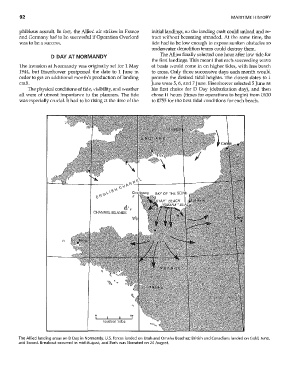
         The Allied landing areas on D Day in  Normandy. U,S. forces  landed on Utah and Omaha Beaches;  British  and Canadians landed on Gold. Juno,
         and  Sword.  Breakout occurred in  mid-August, and Paris was  liberated on 24 August.

