


Page 96 - NS-2 Textbook
P. 96
WORLD WAR II: THE  ATLANTIC WAR                                                                        89


       tion charges, closed the sea valves, and caphued the  U-
       boat and her entire crew. They then pumped out the wa-
       terlogged boat and towed her to Bermuda. After the war
       the U-505 was restored, and has since been on display at
       the Museum of Science and Indush'Y in Chicago, TIlinois.
           In all,  the Allies lost 2,775 merchant ships, amount-
       ing to 23 million tons dming the Battle of the Atlantic. Of
       this, 14.5 million tons were slmk by German U-boats. The
       Germans entered 1,175  U-boats into  the wal;  of which
       they lost 781. They used the capital ships they had at the
       beginning of the war and those completed during it as
       independent smface raiders. Though they scored some
       notable successes, 1110St of these '''ere eventually hlulted
       down by the Allies and Slmk or blockaded in port.


               THE WAR IN  EUROPE  AND AFRICA

       In the spring of 1942  the German armies were consoli-
       dating  their  positions  in  France  and  North  Africa.
       Nowhere were things going well for the Allies. American
       military leaders and Stalin in the Soviet Union wanted to
       bring the \.-var  directly to Hitler with an invasion in Eu-
       rope. But cooler British heads prevailed, convincing Pres-
       ident Roosevelt that the Allies were not ready for such a
       major undertaking in the face of Hitler's superior forces.
           Still,  the Allies had to  do something in order to re-
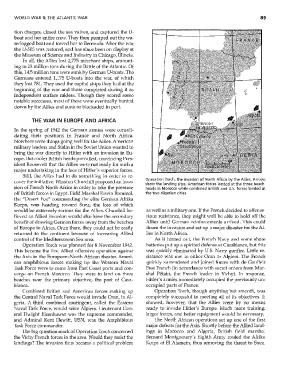
                                                              Operation Torch,  the invasion of North Africa  by the Allies. Arrows
       cover the initiative. Winston Churchill proposed an inva-
                                                              show the landing sites. American forces landed  at the three beach-
       sion of French North Africa in order to take the pressme   heads in  Morocco while combined British and u.s.  forces landed at
       off British forces in Egypt. Field Marshal Erwin Rommel,   the two Algerian cities.
       the  "Desert Fox"  commanding the elite German Afrika
       Korps,  was  heading  toward  Suez,  the  loss  of  which
       would be extremely serious for  the Allies.  Churchill be-  as well as a military one. If the French decided to offer se-
       lieved an Allied invasion would also have the secondary   rious resistance, they might well be able to hold off the
       benefit of drawing German forces away from the beaches   Allies until German reinforcements anived. This could
       of Europe to Africa. Once there, they could not be easily   dOOlll the invasion and set up a lllajor disaster for the Al-
       rehUned  to  the continent because  of increasing Allied   lies in North Africa.
       control of the Mediterranean Sea area.                     As  it turned out,  the  French Navy and  some shore
           Operation Torch was planned for 8 November 1942.   batteries put up a spirited defense at Casablanca, but this
       This became the first Allied offensive operation against   was quickly eliminated by U.S.  Navy glmfire. Little re-
       the Axis in the European-North African theater. Ameri-  sistance was met in either Oran or Algiers.  The French
       can  amphibious  forces  making  up  the  Western  Naval   quickly surrendered and joined forces  with de Gaulle's
       Task Force were to come from East Coast ports and con-  Free French (in accordance with secret orders from Mar-
       verge  on French Morocco.  They were  to land on three   shal  Petain,  the  French  leader  in  Vichy).  In  response,
       beaches  near  the  primary  objective,  the  port  of  Casa-  Hitler's armies immediately occupied the previously un-
       blanca.                                                occupied parts of France.
           Combined  British  and American  forces  making  up    Operation Torch, though anything but smooth, was
       the Central Naval Task Force would invade Oran, in Al-  completely successful in meeting all of its objectives. It
       geria.  A third combined contingent,  called  the  Eastern   showed,  howevel~ that  the  Allies  ,vere  by  no  means
       Naval Task Force, would seize Algiers. Lieutenant Gen-  ready  to  invade Hitler's  Europe.  Much more training,
       eral Dwight Eisenhower ,vas the  suprelne commander,   larger forces, and better equipment would be necessary.
       and Admiral Kent  Hewitt,  USN,  was  the  Amphibious      The North African operations set up one of the first
       Task Force commander.                                  major defeats for the Axis. Shortly before the Allied land-
           The big question mark of Operation Torch concerned   ings  in  Morocco  and  Algeria,  British  field  marshal
       the Vichy French forces in the area. Would they resist the   Bernard Montgomery's Eighth Army routed  the Afrika
       landings? The invasion thus became a political problem   Korps at El Alamein, thus removing the threat to Suez.

