


Page 119 - NS-2 Textbook
P. 119
112                                                                                     MARITIME HISTORY

             Instead of takillg five days as originally planned, the
          conquest of Iwo Jima took over a month. It wasn't until
         25 March that the last Japanese h'oops made their final at-
          tack. Only 200 Japanese were captured; all the rest were
         killed.  For  the  first  time  casualties  among  the  assault
          forces  exceeded  those  of  the Japanese  defenders.  Over
          19,000  marines  and  sailors  'were  ,younded  and  nearly
          7,000  were killed. Admiral Nimitz said the marines on
         hvo Jima made Utmconunon valor a COIllillon virtue./;


                     THE  BATILE  OF  OKINAWA
         The  ,var  was  now  closing  in  on  the  home  islands  of
         Japan.  From  the  middle  of  February,  carrier  aircraft
         began striking  the Japanese  cities  with high explosives
          and incendiaries. On 25 February, even before hvo ,vas
          secured,  fighters  from  TF-58  supported  200  B-29s  in  a
         massive raid on Tokyo, burning out 2 square miles of the
         enemy capital and destroying 150 Japanese aircraft. Af-
          terward, TF-58  steamed past Okinawa, bombing the is-
         land's airfields and taking intelligence photographs. The
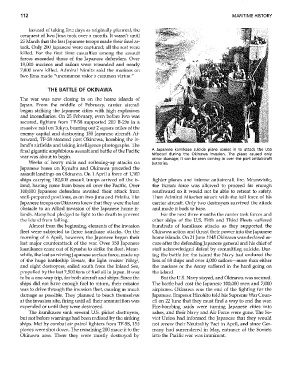
         final gigantic amphibious assault and battle of the Pacific   A  Japanese  kamikaze  suicide  plane  comes  in  to  attack  the  USS
                                                                Missouri  during  the  Okinawa  invasion.  The  plane  caused  only
         war was about to begin.                                minor  damage;  it can  be  seen  coming  in  over the port antiaircraft
             Weeks  of heavy raids  and  softening-up  attacks  on   batteries.
         Japanese bases on Kyushu and Okillawa preceded the
          assault landings on Okinawa. On 1 April a force of 1,300
         ships canying 182,000 assault troops arrived off the is-  fighter planes and intense antiaircraft fire.  Meanwhile,
         land, having come from bases all over the Pacific. Over   the  Yall/aia  force  was  allowed  to  proceed  far  enough
         100,000  Japanese  defenders  awaited  their  attack  from   southward so it would not be able  to  retreat to  safety.
         well-prepared positions, as on 1wo Jima and Peleliu. The   Then Admiral Mitscher struck with the full force of his
         Japanese troops on Okinawa knew that they were the last   carrier aircraft. Only two destroyers survived the attack
         obstacle to  an Allied invasion of the Japanese home is-  and made it back to base.
         lands. Many had pledged to fight to the death to prevent   For the next three months the carrier task forces and
          the island from falling.                               other ships  of the  U.S.  Fifth  and 111ird  Fleets  suffered
             Almost from the begimling, elements of the invasion   hlmdreds  of  kamikaze  attacks  as  they  supported  the
         fleet were subjected  to  fierce  kamikaze  attacks.  On the   Okillawa action and thrust their power into the Japanese
         morning of 6 April, however,  the Japanese began their   home islands. On 21 June 1945 Okinawa was declared se-
         last major counterattack of the war.  Over 350 Japanese   cure after the defending Japanese general and his chief of
         kamikazes came out of Kyushu to strike the fleet. Mean-  staff acknowledged defeat by committing suicide. Dur-
         while, the last surviving Japanese surface force, made up   ing the battle for  the island the Navy had endured the
         of the  huge  battleship  Yama!o,  the  light cruiser  Yalwgi,   loss of 68 ships and over 4,000 sailors-more than either
         and eight destroyers, sailed south from the Inland Sea,   the marines or the Army suffered in the hard going on
         propelled by the last 2,500 tons of fuel oil in Japan. It was   the island.
         to be a one-way trip, for both aircraft and ships. Since the   But the U.s. Navy stayed, and Okillawa was secured.
         ships did not have enough fuel to return, their mission   The battle had cost the Japanese 100,000 men and 7,000
         was to drive through the invasion fleet, causing as much   airplanes. Okinawa was  the end of the fighting  for  the
         damage as possible. They planned to beach themselves   Japanese. Emperor Hirohito told his Supreme War Coun-
         at the invasion site, firing lmtil all their anununition was   cil on 22 June that they must find a way to end the war.
         expended or until they were destroyed.                  Fire-bombing  raids  were  turning  Japanese  cities  into
             The kamikazes sank several U.s.  picket destroyers,   ashes, and their Navy and Air Force were gone. The So-
         but not before warnings had been radioed by the sinkillg   viet Union had informed the Japanese that they would
         ships. Met by combat air patrol fighters from TF-58, 150   not renew their Neutrality Pact in April, and since Ger-
         planes were shot down. The remaining 200 made it to the   many had sunendered in May,  entrance  of the  Soviets
         Okinawa  area.  There  they  'were  1110Stly  destroyed  by   into the Pacific ,val' vvas inuninent.

