


Page 121 - NS-2 Textbook
P. 121
114                                                                                     MARITIME HISTORY


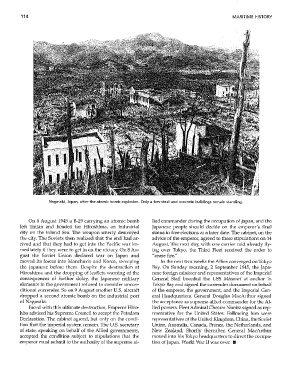
                     Nagasaki, Japan,  after the atomic bomb explosion.  Only a few steel and concrete buildings remain standing.


             On 6 August 1945 a B-29 carrying an atomic bomb    lied commander during the occupation of Japan, and the
         left  Tinian  and  headed  for  Hiroshima,  an  industrial   Japanese  people should  decide  on  the  emperor's  final
         city  on the Inland  Sea.  The weapon utterly destroyed   status in free elections at a later date. The cabinet, on the
         the city.  The Soviets then realized that the end had ar-  advice of the emperOl; agreed to these stipulations on 14
         rived and that they had to get into the Pacific war im-  August. The next day, with one carrier raid already fly-
         mediately if they were to get in on the victory. On 8 Au-  ing  over  Tokyo,  the  Third  Fleet  received  the  order  to
         gust  the  Soviet  Union  declared  war  on  Japan  and   Ucease fire. H
         moved its forces  into Manchuria  and Korea,  svveeping    1n the next two weeks the Allies converged on Tokyo
         the  Japanese  before  them.  Despite  the  destruction  at   Bay.  On Sunday morning,  2 September 1945,  the Japa-
         Hiroshima and the dropping of leaflets warning of the   nese foreign lninister and representatives of the Imperial
         consequences  of  further  delay,  the  Japanese  military   General  Staff  boarded  the  USS  Missouri  at  anchor  in
         elements in the goverrunent refused to consider lfficon-  Tokyo Bay and signed the surrender document on behalf
         ditional surrender. So on 9 August another U.S. aircraft   of the emperOl;  the government, and the Imperial Gen-
         dropped a second atomic bomb on  the industrial port   eral Headquarters. General Douglas MacArthur signed
         of Nagasaki.                                            the acceptance as supreme allied commander for the Al-
             Faced with this ultimate desh'uction, Emperor Hiro-  lied powers. Fleet Admiral Chester Nimitz signed as rep-
         hito advised his Supreme Council to accept the Potsdam   resentative  for  the  United  States.  Following  him  were
         Declaration. The cabinet agreed, but only on the condi-  representatives of the United Kingdom, China, the Soviet
         tion that the imperial system remain. The U.S. secretary   Union, Australia, Canada, France, the Netherlands, and
         of state, speaking on behalf of the Allied  governments,   New  Zealand.  Shortly  thereafter,  General  MacArthur
         accepted  the  condition  subject  to  stipulations  that  the   moved into his Tokyo headquarters to direct the occupa-
         emperor must submit to the authority of the supreme al-  tion of Japan. World War II was over.  III

