


Page 126 - NS-2 Textbook
P. 126
THE  COLD WAR ERA                                                                                     119


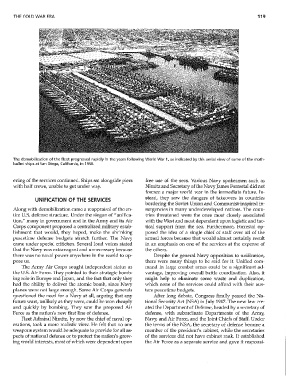
       The  demobilization of the fleet progressed  rapidly in the years following World War II,  as  indicated by this aerial view of some of the moth-
       balled ships  at San  Diego,  California, in  1950.


       ening of the services continued. Ships sat alongside piers   free  use of the  seas.  Various  Navy spokesmen such as
       vdth half cre,Ys, lillable to get under ·way.          Nimitz and Secretary of the Navy James Forrestal did not
                                                              foresee a major world ,varin the inunediate future.  In-
                UNIFICATION  OF THE  SERVICES                 stead,  they  saw  the  dangers  of takeovers  in  cotmtries
                                                              bordering the Soviet Union and Communist-inspired in-
       Along with demobilization came a reappraisal of the en-  surgencies in many tmderdeveloped nations. The coun-
       tire u.s. defense structure. Under the slogan of "unifica-  tries  threatened  were  the  ones  most closely  associated
       tion/' many in goverrunent and in the Arnl)' and its Air   with the West and most dependent upon logistic and tac-
       Corps component proposed a centralized military estab-  tical  support from  the  sea.  Furthermore,  Forrestal  op-
       lishment that  would,  they hoped,  make  the  shrinking   posed the  idea  of a  single chief of staff over all of the
      peacetime  defense  budgets  stretch  htrther.  TIle  Navy   armed forces because that would almost certainly result
       came under special criticism. Several loud voices stated   in an enlphasis on one of the services at  the expense of
       that the Navy "vas extravagant and unnecessary because   the others.
       there ,vas no naval power anywhere in the world to op-    Despite the general Navy opposition to tmification,
      pose us.                                                there were many things  to be said for  it.  Unified  com-
          The Army Air Corps sought independent status as     mand in large  combat areas  could be a  significant  ad-
       the U.S. Air Force. They pointed to their strategic bomb-  vantage, improving overall battle coordination. Also, it
       ing role in Europe and Japan, and the fact that only they   might help  to  eliminate  some  waste  and  duplication,
      had the ability to deliver the atomic bomb, since Navy   which none of the services could afford with their aus-
      planes were not large enough. Some Air Corps generals   tere peacetime budgets.
       questioned the need for  a Navy at all, arguing that any   After long debate, Congress finally passed the Na-
      future wars, unlikely as they were, could be won cheaply   tional Security Act (NSA) in July 1947. The new law cre-
      and  quickly  by bombing.  They saw  the  proposed Air   ated the Department of Defense, headed by a secretary of
      Force as the nation's new first line of defense.        defense,  with  subordinate  Departments  of  the  Army,
          Fleet Admiral Nimitz, by now the chief of naval op-  Navy, and Air Force, and the Joint Chiefs of Staff. Under
      erations, took a more realistic view. He felt that no one   the terms of the NSA, the secretary of defense became a
      weapons system would be adequate to provide for all as-  member of the presidenfs cabinet, while the secretaries
      pects of national defense or to protect the nation's grow-  of the services did not have cabinet rank. It established
      ing world interests, most of which were dependent upon   the Air Force as  a separate service and  gave it responsi-

