


Page 128 - NS-2 Textbook
P. 128
THE  COLD WAR ERA                                                                                    121


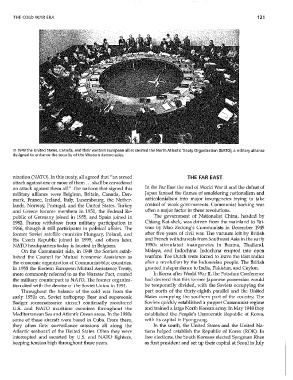
       In 1949 the United States, Canada, and their western European allies created the North Atlantic Treaty Organization (NATO), a military alliance
      designed to enhance the security of the Western democracies.


      nization (NATO). In this treat)\ all agreed that" an armed               THE  FAR  EAST
      attack against one or more of them ... shall be considered
      an attack against them all." The nations that signed this   In the Far East the end of World War II and the defeat of
      military  alliance  were  Belgium,  Britain,  Canada,  Den-  Japan fanned the flames of smoldering nationalism and
      mark,  France,  Iceland,  Italy,  Luxembourg,  the  Nether-  anticolonialism  into  major  insurgencies  hying  to  take
      lands, Norway, Portugal, and the United States. Turkey   control of weak governments. Commwlist backing was
      and  Greece became members  in  1951,  the  Federal Re-  often a major factor in these revolutions.
      public of Germany joined  in  1955,  and Spain joined in   TIle  government  of  Nationalist  China,  headed  by
      1982.  France  withdrew  from  military  participation  in   Chiang Kai-shek/ "vas  driven from the Inainland to  Tai-
      1966, though it still participates in political affairs.  The   wan by Mao Zedong's Communists in December 1949
      former Soviet satellite countries  Hlmgary,  Poland, and   after five  years of civil war. TIle vacumn left by British
      the  Czech  Republic  joined  in  1999,  and  others  later.   and French withdrawals from Southeast Asia in the early
      NATO headquarters today is located in Belgitun.         1950s  stimulated  insurgencies  in  Burma,  Thailand,
          On the Commwust side, in 1949  the Soviets estab-  Malaya,  and  Indochina.  Indochina  erupted  into  open
      lished the  Council for  Mutual Econonuc Assistance  as   warfare. The Dutch were forced to leave the East Indies
      the economic organization of Communist-bloc cOlllltries.   after a revolution by the Indonesian people. The British
      In 1955 the Eastern European Mutual Assistance Treaty,   granted independence to India, Pakistan, and Ceylon.
      more commonly referred to as the Warsaw Pact, created      In Korea after World War II, the Potsdam Conference
      the military counterpart to NATO. The former organiza-  had decreed that this former Japanese possession would
      tion died with the demise of the Soviet Union in 1991.   be temporarily divided, with the Soviets occupying the
          Throughout  the  balance  of  the  cold  war  from  the   part north of the  thirty-eighth parallel and  the Unlted
      early  1950s  on,  Soviet  turboprop  Bear  and  supersonic   States  occupying  the southern part of the  country.  The
      Badger  recOlmaissance  aircraft  continually  monitored   Soviets quickly established a puppet Commwlist regime
      U.S.  and  NATO  maritime  exercises  throughout  the   and trained a large North Korean army. In May 1948 they
      Mediterranean Sea and Atlantic Ocean areas. In the 1980s   established the People's Democratic Republic of Korea,
      some of these aircraft were based in Cuba. From there,   with its capital in Pyongyang.
      they  often  flew  surveillance  missions  all  along  the   In the south,  the United States and the United Na-
      Atlantic seaboard of the United States. Often they were   tions helped establish the Republic  of Korea  (ROK).  In
      intercepted  and  escorted  by  U.S.  and  NATO  fighters,   free elections, the South Koreans elected Syngman Rhee
      keeping tension high throughout these years.           as first president and set up their capital at Seoul in July

