


Page 131 - NS-2 Textbook
P. 131
124                                                                                     MARITIME HISTORY

                                                                              ..


                             . .


                                LANDING AT INChON
                                    I'Stpt.19SO
                                                                 ..
                                                              ..
                              c  ,

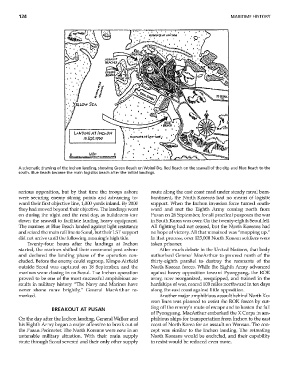
         A schematic drawing of the Inchon landing, showing Green Beach  on Wolmi-Do, Red  Beach on the seawall of the city,  and  Blue Beach to the
         south.  Blue Beach  became the main logistics beach after the initial landings.


         serious  opposition,  but by  that  time  the  troops  ashore   route along the east coast road under steady naval bom-
         were  securing  eI1€Iny  strong  points  and  advancing  to-  bardment, the North Koreans had no means of logistic
         ward their first objective line, 1,000 yards inland. By 2000   support.  When the Inchon invasion force  turned south-
         they had moved beyond their objective. 111e landings went   ward  and  met  the  Eighth  Army  coming  north  from
         on during the night and the next day,  as bulldozers tore   Pusan on 26 September, for all practical purposes the war
         down the seawall to facilitate landing heavy equipment.   in South Korea ,vas over. On the hventy-eighth Seoul fell.
         The marines at Blue Beach landed against light resistance   All fighting had not ceased, but the North Koreans had
         and seized the main rail line to Seoul, but their LST support   no hope of victory. All that remained was" mopping up."
         did not arrive until the following moming's high tide.   h1 that process, over 125,000 North Korean soldiers were
            Twenty-four  hours  after  the  landings  at  Inchon   taken prisoner.
         started, the marines shifted their command post ashore     After much debate in the United Nations, that body
         and  declared  the  landing phase  of  the  operation con-  authorized General MacArthm to proceed north of the
         cluded. Before the enemy could regroup, Kimpo Airfield   thirty-eighth  parallel  to  destroy  the  remnants  of  the
         outside Seoul was  captured  on 18  September,  and the   North Korean forces.  While the Eighth Army advanced
         marines ""ere closing in on Seoul. The Inchon operation   agamst heavy opposition toward Pyongyang,  the ROK
         proved to be one of the most successful amphibious as-  army,  now reorganized, reequipped, and  trained in the
         saults in military histOlY.  "The Navy and Marines have   hardships of wal~ roared 100 miles northward in ten days
         never  shone  more  brightly,"  General  MacArthur  re-  along the east coast against little opposition.
         marked.                                                    Another major amphibious assault behind North Ko-
                                                                rean lines was planned to assist the ROK forces by cut-
                                                                ting off the enemy's route of escape and to hasten the fall
                       BREAKOUT AT  PUSAN
                                                                of Pyongyang. MacArthur embarked the X Corps in an1-
         On the day after the Inchon landing, General Walker and   phibious ships for transportation from Inchon to the east
         his Eighth Army began a major offensive to break out of   coast of North Korea for an assault on Wonsan. The con-
         the Pusan Perilneter. The North Koreans 'were 11mv in an   cept was  similar  to  the  Inchon landing.  The reh'eating
         untenable  military  situation.  With  their  main  supply   North Koreans would be encircled, and  their capability
         route through Seoul severed and their only other supply   to resist ,vould be reduced even more.

