


Page 133 - NS-2 Textbook
P. 133
126                                                                                     MARITIME HISTORY


                                                                           DISMISSAL OF  MACARTHUR
                                                                General  MacArthur  had  hated  the  limitations  placed
                                                                upon him after the Chinese intervened. He particularly
                                                                wanted to be allowed to follow Chinese aircraft in "hot
                                                                pursuit"  over  the  Yalu  River  into  Manchuria  and  to
                                                                bomb  Chinese staging bases  on the north bank of the
                                                                river. The Western European allies put great pressure on
                                                                the United States to forbid such action. They feared that
                                                                the war would escalate and eventually involve the Sovi-
                                                                ets on the basis of the Sino-Soviet Mutual Defense Treaty.
                                                                This opinion was shared by the U.S.  State Department,
                                                                and their view prevailed with the president.
                                                                   When he ·was unable to persuade President Truman
                                                                to accept his reconrrnendations, in March 1951  General
                                                                MacArthur sent a letter attacking the president's policies
                                                                to Joseph Martin,  the minority leader of the House  of
                                                                Representatives.  When Martin  made  the  letter  public,
                                                                President Truman relieved MacArthur for insubordina-
                                                                tion, replacing him with General Ridgway.
                                                                   In his letter, MacArthur pointed out that "Europe's
                                                                war against the Communists was being fought in Asia
                                                                with arms, wIllie  the diplomats  there still fight  it with
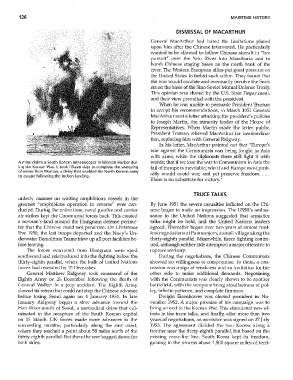
         A mine claims a South Korean minesweeper in Wonsan Harbor dur-  words; that if we lose the war to Communism in Asia the
         ing the Korean  War.  It took fifteen days to complete the sweeping   fall of Europe is inevitable; win it and Europe most prob-
         of mines from Woman, a delay that enabled the North Korean army
         to escape following the Inchon landing.                ably would avoid war,  and yet preserve freedom.
                                                                There is no substihlte for victory."

                                                                                  TRUCE  TALKS
         orderly manner  on waiting  amphibious  vessels  in  the
         greatest  U amphibious  operation  in  reverse U   ever  con-  By Jrrne 1951  the severe casualties inflicted on the Chi-
         ducted. During the entire time, naval gunfire and carrier   nese began to make an impression. The USSR's ambas-
         air strikes kept the Communist forces back. This created   sador  to  the  United  Nations  suggested  that  armistice
         a no-man's-land around the Htmgnam defense perime-     talks  might  be  held,  and  the  United  Nations  leaders
         ter that the Chinese could not penetrate. On Christmas   agreed. Thereafter began over two years of almost fruit-
         Eve 1950,  the last troops departed and the Navy's Un-  less negotiations at Panmunjom, a small village along the
         derwater Demolition Teams blew up all port facilities be-  thirty-eighth parallel. Meanwhile, fierce fighting contin-
         fore leaving.                                          ued, although neither side attempted a major offensive to
            The  forces  evacuated  from  Hungnam  were  sped   caphrre territory.
         southward and reintroduced into the fighting below the    During  the  negotiations,  the  Chinese  Communists
         thirty-eighth parallel, where the bulk of United Nations   showed no \villingness to  compromise. To  thenl,  a con-
         forces had retreated by 15 December.                   cession was a sign of weakness and an invitation for the
            General  Matthew  Ridgway  took  command  of  the   other  side  to  make  additional  demands.  Negotiating
         Eighth  Army  on 26  December  following  the  death  of   with the Communists was clearly shown to be another
         General  Walker  in  a  jeep  accident.  TIle  Eighth  Army   battlefield, with the weapons being steadfashless of pol-
         slowed its retreat but could not stop the Chinese advance   icy, infinite patience, and complete firrrmess.
        before  losing  Seoul  again  on  4  January  1951.  In  late   Dwight  Eisenhower  was  elected  president  in  No-
        January  Ridgway  began  a  slow  advance  toward  the   vember 1952. A major promise of his campaign was to
        Han River south of Seoul, a  methodical drive  that cul-  bring an end to the Korean War. This stimulated new ef-
         minated  in  the  recaphrre  of  the  South Korean  capital   forts in the truce talks, and finally,  after more than two
         on  15  March.  UN  forces  made  more  advances  in  the   years of negotiations, an armistice was signed on 27 July
         succeeding  months,  particularly  along  the  east  coast,   1953.  The  agreement  divided  the  two  Koreas  along  a
         where they reached a point about 50 nllies north of the   frontier near the thirty-eighth parallel, but based on the
         thirty-eighth parallel. But there the war bogged down for   existing  cease-fire  line.  South  Korea  kept  its  freedom,
        both sides.                                             gaining in the process about 1,500 square miles of terri-

