


Page 134 - NS-2 Textbook
P. 134
THE  COLD WAR ERA                                                                                     127


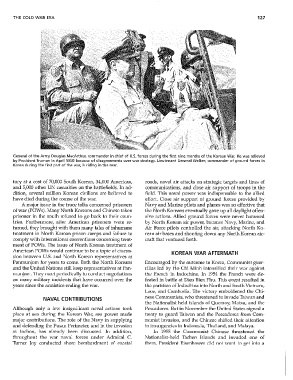
       General of the Army Douglas MacArthur, commander in chief of U.S.  forces during the first nine months of the Korean War.  He was  relieved
       by  President Truman  in  April  1950 because  of disagreements over war strategy.  Lieutenant  General Walker,  commander of ground forces  in
       Korea during the first part of the war,  is  riding in the rear.


       tory at a cost of 70,000 South Korean, 34,000 American,   roads, naval air attacks on strategic targets and lines of
       and 5,000 other UN casualties on the battlefields. In ad-  commwucations, and close air support of troops in the
       dition,  several million Korean  civilians  are  believed  to   field.  This naval power was indispensable to the allied
      have died during the course of the war.                 effort.  Close  air  support of  grOlmd  forces  provided by
          A major issue in the truce talks concerned prisoners   Navy and Marine pilots and planes was so effective that
      of war (POWs). Many North Koreans and Chinese taken     the North Koreans eventually gave up all daylight offen-
      prisoner in the  south refused to go back to  their coun-  sive  actions.  Allied  ground forces  -were  never harassed
      tries.  Flu'thermore,  after  American  prisoners  were  re-  by North Korean ail' pOV\Ter,  because Navy, Mal'ine, and
      turned, they brought with them many tales of inhumane   All' Force pilots controlled the ail;  attacking North Ko-
      treatment in North Korean prison camps and failure  to   rean air bases and shooting down any North Korean air-
      comply with international conventions concerning treat-  craft that ventmed forth.
      ment of POWs. The issue of North Korean treatment of
      American POWs would continue to be a topic of discus-
                                                                         KOREAN  WAR AFTERMATH
      sion between U.S.  and North Korean representatives at
      Panmunjom for years to come. Both the North Koreans     Encomaged by the outcome in Korea, Communist guer-
      and the United Nations still keep representatives at Pan-  rillas led by Ho Chi Minh intensified their war against
      mlmjom. They meet periodically to conduct negotiations   the  French  in Indochina.  In 1954  the  French were  de-
      on many military incidents that have occurred over the   feated in battle at Dien Bien Phu. This event resulted in
      years since the armistice ending the war.               the partition of Indochina into North and South Vietnam,
                                                              Laos, and Cambodia. The victory emboldened the Chi-
                                                             nese Communists, who threatened to invade Taiwan and
                   NAVAL CONTRIBUTIONS
                                                              the Nationalist-held islands of Quemoy, Matsu, and the
      Although  oniy  a  few  insignificant  naval  actions  took   Pescadores. But in November the Uluted States signed a
      place  at sea  during  the  Korean  Wm;  sea  power  made   treaty to  guard Taiwan and the Pescadores  from  Com-
      major contributions. The role  of the Navy in supplying   munist invasion, and the Chinese shifted their attention
      and defending the Pusan Perimetel; and in the invasion   to insurgencies in Indonesia, Thailand, and Malaya.
      at  Inchon,  has  already  been  discussed.  In  addition,   In  1955  the  COllummist  Chil1ese  threatened  the
      throughout  the  war  naval  forces  under  Admiral  C.   Nationalist-held  Tachen  Islands  and  invaded  one  of
      Turner  Joy  conducted  shore  bombardment  of  coastal   them.  President Eisenhower did not want to get into a

