


Page 137 - NS-2 Textbook
P. 137
130                                                                                     MARITIME  HISTORY


                    THE  CUBAN  MISSILE CRISIS                  "Well,  it looks  as  if  everything is  in the  hands  of  the
                                                                Navy,n
         As  potentially  explosive  as  the  incidents  between  the   Admiral Anderson replied, "Mr. President, the Navy
         U.S.  and communism in the late 1940s and 1950s were,   will not let you down."
         the 1962 Cuban missile crisis was the most dangerous of    The next evening, 21  Octobel~ the president V\Tent on
         all cold war crises to that date. It was a direct confronta-  national television and told the American people and the
         tion between the United States and the Soviet Union.   world that the Soviet Union had placed missiles in Cuba.
             On 14 October 1962 high-flying U-2 reconnaissance   He announced  that "a strict quarantine of  all offensive
         aircraft on photographic intelligence missions positively   equipment ,mder shipment to  Cuba is being initiated,"
         identified Soviet ICBM launching pads IUlder construc-  and that ally ship bound for  Cuba carrying such cargo
         tion  in  Fidel  Castro's  Cuba.  Earlier  photographs  had   would be met by the US. Navy alld turned back. By 24
         shown surface-to-air missile batteries being erected and   October over 180 Navy ships 'were involved in the oper-
         Soviet-flag  freighters  laden  with  electronic  geal;  con-  ation, establishing a quarantine line on an arc 500 miles
         struction equipmentf and even suspected crated lllissiles   to the east of Cuba. Naval vessels and aircraft continu-
         being unloaded in Cuban ports. With proof of the ICBM   ously  conducted  reconnaissance  missions  over  and
         sites confirmed, it became obvious that the Soviets were   aroUlld the island.
         trying to overcome the superiority of America's Polaris    Soviet Premier Nikita Khrushchev branded the U.S.
         lnissile submarines by placing the majority of American   charges  as lies  and ,yarned that if Alnerica  carried out
         cities well within the 2,200-mile range of Soviet missiles.   any act of Upiracy," the Soviet Union ,vould react accord-
            President Kennedy had only two  choices:  do noth-  ingly. Work on the missile sites continued. Thirty thou-
         ing, and make the United States vulnerable to Soviet nu-  sand US. marines embarked in amphibious ships near
         clear blackmail, or force  the Soviets to remove the mis-  Cuba  made  preparations  to  invade  the  island.  Intelli-
         siles, even at the threat of nuclear war. After an agonizing   gence  reported  that  hventy-five  Soviet  ships  were  on
         appraisal of the  alternatives,  the president called upon   their way to Cuba and nearing the quar-antine line. The
         the US. Navy to establish a quarantine (a type of selec-  question was, would they turn back, would they have to
         tive blockade)  of Cuba. Having made the decision, the   be  boarded  and  captured,  or  would  they  have  to  be
         president  told  Admiral  George  Anderson,  then  CNO,   SlUlk? Tension rose. War seemed only hours away.


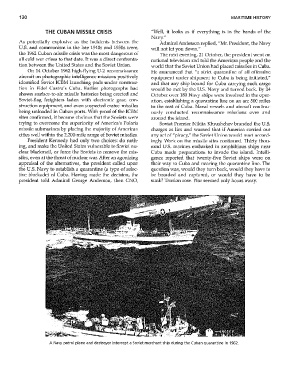
                      A Navy patrol plane and destroyer intercept a Soviet merchant ship  during the Cuban quarantine in  1962.

