


Page 176 - NS-2 Textbook
P. 176
APPROACHES TO  LEADERSHIP                                                                             169


       Autocratic  style.  The  autocratic  or  authoritarian  style  of   problems.  To  make  the  democratic  style  work,  a  leader
       leadership is centered on the leader. It is direct and often   needs cooperation from his or her people. The democratic
       impersonal. It demands a fast response, as in a drill or an   leader can encourage his or her subordinates to  do their
       emergency situation.                                   part. They will accept his or her leadership. Then everyone
          The autocratic leader has the responsibility to direct   will be more willing to work to get the job done.
       a group effort.  Subordinates don't openly question this   The democratic leader allows people some leeway or
       leader's commands.  They  are  seldom free  to  use  their   freedom in carrying out their tasks, as long as they get the
       own initiative. The emphasis is on carrying out orders.   job done. The people doing the job can then have some of
          The  autocratic  leader uses  position  as  the basis for   the authority for getting it done. They develop pride in
       leadership. He or she isn't much concerned about rela-  their work, and teamwork grows.
       tionships with subordinates. 111is approach won't build a   Democratic groups produce better over longer peri-
       closely-knit group. It doesn't encourage a free exchange   ods  of  time  than autocratic  groups  do.  They can  also
       of ideas between the leader and the group.             keep producing when the leader is not present.
          Autocratic leadership will get the job done quickly.
       Groups working wlder this type of leader produce well
                                                                       RANGE  OF  LEADERSHIP STYLES
       for short periods of time, when the leader is present. But
       production usually goes  down over longer periods, or   How should the leader try to get people to do the job? Ef-
       when the leader isn't armmd. Followers depend so much   fective  leadership is based on results.  Use  of authority
       on the leader that they can't act independently when the   alone may not always produce the best results. Conversely,
       leader is not there.                                   a completely democratic style in which the leader avoids
          The purely autocratic approach has its place for  all   taking  responsibility  and  simply  goes  along  with  the
       leaders in certain sihwtions. But in most day-to-day con-  group is seldom appropriate either.
       ditions, the leader should be more sensitive to the needs   Within the range of leadership styles from autocratic
       of subordinates. Then he or she will get a better response   to  democratic,  there  are  five  different  approaches  to
       when direct orders are really required.                leadership.

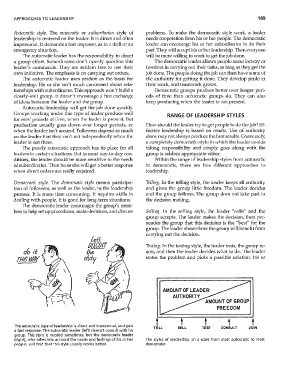
       Democratic  style.  The  democratic  style  means  participa-  Telling.  In the telling style, the leader keeps all authority
       tion of followers, as well as the leader, in the leadership   and gives  the group little  freedom.  The leader decides
       process. It is more time consuming. It requires skills in   and the group follows. The group does not take part in
       dealing with people. It is good for long-term situations.   the decision making.
          The democratic leader encourages the group's mem-
       bers to help set up procedures, make decisions, and discuss   Selling.  In  the  selling  style,  the  leader  "sells"  and  the
                                                              group accepts. The leader makes the decision, then per-
                                                              suades the group that this decision is the "best" for the
                                                              group. The leader shows how the group will benefit from
                                                              carrying out the decision.


           do  /6   ~                                         Testing. In the testiog style, the leader tests, the group re-
                                                              acts, and then the leader decides what to do. The leader
        [II/SWAY      /:/'\                                   states the problem and picks a possible solution. He or
                     ,z ,\


                                                                     AMOUNT OF LEADER
                                                                         AUTHORITY
                       \-  \                                                           AMOUNT OF GROUP
                                                                                           FREEDOM

                                                                  t         t         t         t         t
       The autocratic type of leadership is direct and impersonal, and gets   TELL   SELL   TEST   CONSULT   JOIN
       a fast response. The autocratic leader (left) doesn't consult with his
       group.  This  style  is  needed sometimes,  but the  democratic  leader
       (right), who takes into account the needs and feelings of his or her   The  styles  of leadership,  on  a scale  from  most autocratic  to most
       people, will  find that this style usually works better.   democratic.

