


Page 177 - NS-2 Textbook
P. 177
170                                                                                            LEADERSHIP


          she lets the group react to this solution and may accept   When delegating authority, it is inlportant to set clear
          suggestions. He or she then makes the final decision and   and concise limits for  the individual or group to operate
          informs the group.                                     within,  as  well as  to  specify the  goal  and any time  con-
                                                                 sh'aints that may apply. Then, as long as the individual or
          Consulting. In the consulting style, the leader presents the   group can stay within the given limits, decisions as to how
          problem and asks for ideas from the group members. The   to proceed can be made by the individual or group without
          group makes recommendations. The leader then selects a   any ftu'lher presence of or direction by the leader. Should it
          solution and informs the group of his or her decision.   become necessary to exceed the limits, the leader must be
                                                                 so advised in all except emergency conditions before pro-
          Joining.  In the joining style, the  group decides  and the   ceeding. Depending on tile situation, alternatives may be
          leader follows. Here the leader is just another member of   presented for consideration and approval by the leader, or
          the group. He or she agrees to carry out whatever deci-  further directions may be requested from him or her.
          sion the group makes.
                                                                       LEADERSHIP AND COMMUNICATION
             No  matter  what leadership  style  they  use,  leaders
          caIU10t  be  everyvvhere  all  the  tiIne,  nor  can  they-or   To become a good leader one has to be able to communi-
          should they-try to do everything themselves. 111erelore,   cate.  The  four  skills  necessaty for  communication  are
          regardless of their style, it is frequently necessary for lead-  reading,  writing,  listening,  at1d  speaking.  Let's  discuss
          ers to delegate (give) authority to individuals and groups   each of these briefly.
          in order to get the job done. For example, the command-
          ing officer (CO) of a ship might delegate to the officer-of-  Reading. The ability to be an effective reader is essential
          the-deck (OOD) authority to conduct a routine maneuver   to any leader. He or she must be able to read directives
          in a safe manner at a  time when the CO is not on the   and understand them so he or she can have the group
          bridge.                                                carry them out. On longer articles, instructions, or books,


                                                                                       WELL,
                                                                                         YOU'VE  HAD
                                                                ~                   ;,   YOUR  SAY.
                                                                                          NOW WE'LL
                                                   NOW                              ~./'  DO/TTHIS
                                                    HERE's TilE  ~
                                                                                     ...    WAY,
                                                   Btf?~. ~I~W-l-J '(-.21
                                                               '\,1
                                                   TO 00 IT
                                                   BECAUSE      . i
                                                     JJQJrr)


                                                                                    Tht ttttina Ipptoa<:h.
                                                                      LETS  TAKE.
                                                                       A  VOTE-
                                                                         MAJOR/TV
                                NOW THAT YOU      I~                 " . .-RULES
                                 KNOW  THE  -- .'i¥t,,,              ~
                                  PROBLEM,      ft. '"  (
                                  WHAT 00 YOU  :;:lj r"-)
                                    SUGGEST?        1"'1
                                                   t'
                                        (T\~II
                                      _'r-I:.Je4


                                      1M COI'\Wftlng.pprOO¢h.


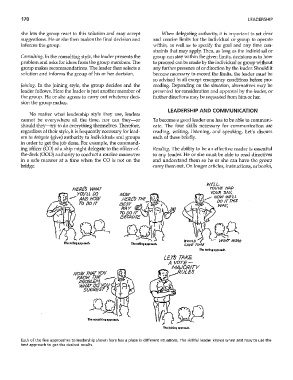
          Each  of the five  approaches to leadership shown here has  a place in different situations. The skillful  leader knows when and how to use the
          best approach to get the desired  results.

