


Page 242 - NS-2 Textbook
P. 242
OCEANOGRAPHY                                                                                          237


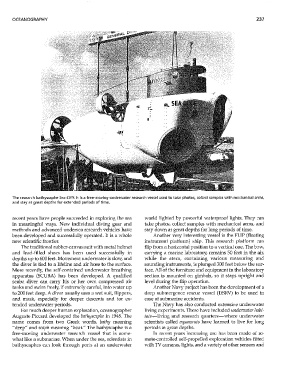
      The research  bathyscaphe Sea  Cliff.  It  is a free-moving underwater research vessel  used to take photos, collect samples with mechanical arms,
      and stay at great depths for extended periods of time.


      recent years have people succeeded in exploring the sea   world lighted by powerful waterproof lights. They can
      in meaningful  ways.  New  individual diving  gear  and   take photos, collect samples with mechanical arms, and
      methods and advanced undersea research vehicles have   stay down at great depths for long periods of time.
      been developed and successfully operated. It is a whole    Another very interesting vessel is the FLIP (floating
      ne,v scientific frontier.                              instrument  platform)  ship.  111is  research  platform can
          The traditional rubber-canvas suit with metal helmet   flip from a horizontal position to a vertical one. The bow,
      and  lead-filled  shoes  has  been  used  successfully  in   carrying a  marine laboratory, remains 50 feet in the ail;
      depths up to 600 fee!. Movement underwater is slow, and   while  the  stern,  containing  various  measuring  and
      the diver is tied to a lifeline and air hose to the surface.   sounding instruments, is plunged 300 feet below the sur-
      More recently,  the self-contained underwater breathing   face. All of the furniture and equipment in the laboratory
      apparatus  (SCUBA)  has  been  developed.  A  qualified   section is mounted on gimbals, so it stays upright and
      scuba  diver  can  carry  his  or  her  own  compressed  air   level during the flip operation.
      tanks and swim freely, if extremely careful, into water up   Another Navy project has been the development of a
      to 200 feet deep. A diver usually uses a wet suit, flippers,   deep submergence rescue vessel  (DSRV)  to be used in
      and  mask,  especially  for  deeper  descents  and  for  ex-  case of sublnarine accidents.
      tended underwater periods.                                 The Navy has also conducted extensive underv,,rater
          For much deeper human exploration, oceanographer   living experinlents. 11,ese have included underwater Izabi-
      Auguste Piccard developed the bathyscaphe in 1948. The   tats-:-living and research quarters-where tmderwater
      name  comes  from  two  Greek  words,  batlzy  meaning   scientists called aquanauts  have learned to live for long
      "deep" and smph meaning "boa!." The bathyscaphe is a   periods at great depths.
      free-moving  underwater  research  vessel  that  is  SOlne-  In recent years increasing use has been made of re-
      V\ 7 hat like a submarine. VVhen wlder the sea, scientists in   mote-controlled self-propelled exploration vehicles fitted
      bathyscaphes can look through ports at an lmdelwater   with TV cameras, lights, and a variety of other sensors and

