


Page 238 - NS-2 Textbook
P. 238
OCEANOGRAPHY                                                                                          233


          The grmving use of tmderwater optical instruments,     The danger of bemg attacked by a shark is exagger-
      such as fixed  television and camera lenses}  has created   ated in the minds of many people. The degree of hazard
      fmther  problems.  Such  lenses  can be fouled  m  a  very   depends both on the location and on the numbers and
      short tillle. Some kind of h'ansparent protective coatillg   condition of the mdividuals m the water. Sharks are Wl-
      must be developed before planned submerged television   predictable and curious and will mvestigate ally object m
      monitoring stations can be mstalled.                   the  water.  They  are  likely  to  attack  the  dead  or  the
          Large stationary structures built on the contillental   wOWlded.  They have all exceptional ability to  detect a
      shelf for both rnilitalY alld commercial projects have ad-  disabled or wounded anilllal at long rallge. Blood m the
      ditional  fouling  problems.  Offshore  oil-drilling  plat-  water attracts  and  excites  them  through  their  sense of
      forms, lighthouses, radar stations, and oceanographic re-  smell.
      search stations are generally intended to be permanent     The largest of all fish m the ocean is the tropical whale
      stnlctures. Fouling and deterioration by bacteria, flmgiJ   shark, which may reach more than 45 feet in length alld
      alld marme animals are serious threats to such platforms.   weigh several tons.  The basking shark and well-known
          Submarme cables contammg telephone and electric    great white shark, both fOWld  m  temperate alld tropical
      power, and wlderwater pipelines, have been attacked by   waters worldwide, may reach lengths in excess of 30 feet
      shrilllplike  anilllals  called  gribbles.  They  have  gnawed   and 20 feet, respectively. The tiger shark averages about 10
      through wooden pilillgs alld rubber and plastic msula-  feet in length but may reach as much as 20 feet.
      tian.  The  famous  teredo,  or  "shipworm/'  can  desh'oy   Sharks are found m all oceans from 45 degrees north
      wooden pilings, burrow into rocks and cement, weaken   to 45 degrees south latihlde. The dallger of shark attack
      stone seawalls,  alld  destroy msulation on cables.  They   appears to be greatest m  tropical alld subtropical areas
      have even drilled through solid lead sheathillg of sub-  between latitudes  of 30  degrees  north  and  30  degrees
      marme power cables laid as deep as 7,200 feet!         south.  TIle  most  dallgerous  areas  are  Australia,  South
                                                             Africa, Cuba, and the Pacific coast of Pallama. In recent
                                                             times}  however}  an increasing nwnber  of shark attacks
                  DANGEROUS  MARINE LIFE                     have occurred on all coasts  of  the  United States, espe-
                                                             cially off Florida beaches. No one knows for sure why the
      People generally thillk of datlger at sea as attack by fear-
                                                             numbers  of  these  shark attacks  is  rismg.  One possible
      some animals. Actually, atlilllallife m  the sea is usually
                                                             cause is  that the  supply of fish m  offshore  areas  upon
      more helpful than harmful. Nevertheless, there are two
                                                             which the sharks normally feed  may be decreasmg be-
      categories of marme species that can be very dallgerous
                                                             cause of pollution and overfishillg.  Although shark at-
      to humans: carnivorous and poisonous or venomous.
                                                             tacks can result m serious mjmy, they are seldom fatal ex-
          Camivorolls Allimais. Sharks are the leadmg carnivores
                                                             cept when the victim is small.
      of most marme ecosystems. Of the 300 species identified,
                                                                 The sharks considered most dangerous to people are
      the larger species are the top predators m  their envITon-
                                                             the great white shark, considered the most dallgerous of
      ment. Although infrequent, shark attack remains a signif-
                                                             all; the tiger shark, probably the most common of tropi-
      icant threat for bathers along the world's seacoasts alld for
                                                             cal sharks; the sand shark, native to East Indian waters;
      people who work in the marine environment.
                                                             and  the  hammerhead  shark,  fOlmd  throughout  the
                                                             oceans m both tropical and temperate zones.
                                                                 When sharks are present, people should not dangle
                                                             arms or legs m  the water. Injured swilllmers should be
                                                             removed  from  the  water  quickly.  Any  flow  of blood
                                                             should be stopped as quickly as possible. Dark clothing
                                                             and equipment are safest for s,vimmers. All movements
                                                             should  be  slow  and  purposeful  to  avoid  attractillg
                                                             sharks;  if they  appear,  swimnlers  should  remain  per-
                                                             fectly still. Some sharks have departed when struck on
                                                             the snout, but this should be done only as a last resort be-
                                                             cause it could aggravate them.
                                                                 Barraclida are extremely dallgerous. They may reach
                                                             6 to  8 feet  long.  TI1ey  have knifelike  catlille  teeth  and,
                                                             bemg  swift  swimmers,  strike  rapidly  and  ferociously.
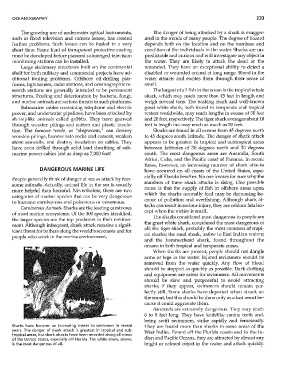
      Sharks  have  become  an  increasing  threat  to  swimmers  in  recent   They are feared more thall sharks in some areas of the
      years.  The  danger  of shark  attack  is  greatest  in  tropical  and  sub-  West Indies. FOlmd off the Florida coasts alld m  the In-
      tropical areas, but shark attacks have been recorded along all coasts
      of the United States, especially off Florida. The white shark, above,   dian and Pacific Oceans, they are attracted by almost ally
      is the most dangerous of all.                          bright or colored object m the water and attack quickly.

