


Page 240 - NS-2 Textbook
P. 240
OCEANOGRAPHY                                                                                          235


                                                                                          Sea  tJrchin
                                                                                        TO  "  INCHES  IN  D1A.,
                                                                                       SPINES  TO  1  FOOT  LONG


                                                                  Killer  Whale
                                                                   TO  35  fEET


                                 TO  6  FEET


                                                                                     Manta  Ray
                       Tridacna                                                     TO  20  fEET  WJDE
                      TO  3  fEET  LONG          Stone fish
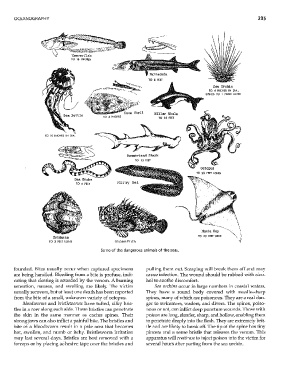
                                           Some  of the dangerous animals of the seas.


       founded.  Bites usually OCClli' when captured specimens   pulling them out. Scraping will break them off and may
       are being handled. Bleeding from a bite is profuse, indi-  cause infection. The wound should be rubbed with alco-
       cating that clotting is retarded by the venom. A burning   hol to soothe discomfort.
       sensation,  nausea,  and  swelling  are  likely.  The  victiIn   Sea  urchins  occur in large numbers in coastal "\,\Taters.
       usually recovers, but at least one death has been reported   They  have  a  round  body  covered  with  needle-sharp
       from the bite of a small, unknown variety of octopus.   spines, many of 'which are poisonous. They are a real dan-
           Bloodworms  and bristleworl1ls  have tufted, silky bris-  ger to  swinuners, waders, and divers. The spines, poiso-
       tles in a row along each side. These bristles can penetrate   nous or not, can inflict deep puncture wounds. Those with
       the  skin  in  the  same  manner  as  cactus  spines.  Their   poison are long, slendel; shalp, and hollow, enabling them
       strong jaws can also inflict a painful bite. The bristles and   to penetrate deeply into the flesh. They are extremely brit-
       bite of a bloodworm result in a pale area that becomes   tle and are likely to break off. The tip of the spine has tiny
       hot, swollen, and numb  or itchy.  Bristle-worm irritation   pincers and a sense bristle that releases the venom. This
       may last several days. Bristles are  best removed with a   apparatus will continue to inject poison into the victim for
       forceps or by placing adhesive tape over the bristles and   several hours after parting from the sea urchin.

