


Page 276 - NS-2 Textbook
P. 276
METEOROLOGY                                                                                          271

                     LIFE  OF A HURRICANE                      This area is relatively calm, with light winds and clear or
                                                               moderately clear skies and a little drizzle.
       The birth of a hurricane often occurs in that region near
                                                                  An Atlantic hurricane, then, starts as a  tropical low,
       the equator where trade winds meet to form  the Inter-
                                                               grows into a storm, and eventually matures into a hurri-
        tropical  Convergence  Zone  (ICZ).  Tropical  cyclones,
                                                               cane when its winds exceed 75 mph. While it is moving
       however, never occur right on the equator because they
                                                              . along its track, it is growing in intensity. By the time it be-
       require the twisting Coriolis forces of Earth's rotation to
                                                               gins to curve to the northeast, it comes over cooler waters
       start them spinning, which are not present there.
                                                               and into cooler air.  Cooling reduces its internal action,
           A hurricane is born in a hot, Inoist air nlass over the
                                                               until it finally dissipates into an extra tropical low,  usu-
        ocean. The rotating low at the ICZ pushes air toward its
                                                               ally ending as a gale or storm over the North Atlantic or
       center, forcing the hot moist air to lift. The lifting causes
                                                               North Sea.
        the moisture to condense. As this moisture condenses, it
                                                                  The  elements  of  wind,  temperature,  pressure,  hu-
       heats the rotating au' morel causing it to rise even more
                                                               midity, and rain vary little in the different quadrants of a
       swiftly.  As more moist tropical sea air sweeps in to  re-
                                                               tropical cyclone. Winds increase from the outer limits to
       place this rising air, more condensation takes place, and
                                                               the edge of the eye.  The temperature rises and the hu-
        the cycle intensifies. That is why hurricanes are so vio-
                                                               midity falls at the center. Precipitation is  in the form of
       lent-because of the tremendous energy released by the
                                                               showers at the  outer limits. It becomes heavier toward
       continuous condensation and an inexhaustible source of
                                                               the center, and is heaviest in the right front quadrant.
       moisture. All the while, the Coriolis effect keeps the air
                                                                  Hurricanes are usually associated with great wind-
        turning more and more rapidly, tmtiI it is a giant wheel
                                                               caused tides called storm surges that inundate the land
        of swirling winds.
                                                               areas they approach, and cause more damage than do the
           Although their tracks cannot be predicted individu-
                                                               wind and rain of the  storm itself.  The doldrums, with
        ally, in general in the Northern Hemisphere hurricanes
                                                               their baffling winds and frequent rain squalls and thun-
        move westward from their point of origin, then curve to
                                                               derstorms,  is  the  breeding  place  of  most  tropical  cy-
        the northeast. In the Southem Hemisphere they start out
                                                               clones.
       westward and then curve southeastward. They vary in
        diameter from  60  to  1,000  mlles.  They  have  moderate   HURRICANES, TYPHOONS, AND THEIR TRACKS
       winds at their outer edges l  increasing tovvard the center,
       where velocities higher than 175  knots  (200  mph) have   Hurricanes occur most frequently in September and Oc-
       been recorded. At the center is an area called the eye  of   tober, but they can happen anytime from June to Decem-
        the  storm, which averages  about 14  mlles in diameter.   ber. A typical hurricane that originates in the doldrums
                                                                                             TOP VIEW


                       wind
                                                                                                low
                                                              TOP VIEW                       pressure,
                                                                                             no wind,
                                                                                             few clouds

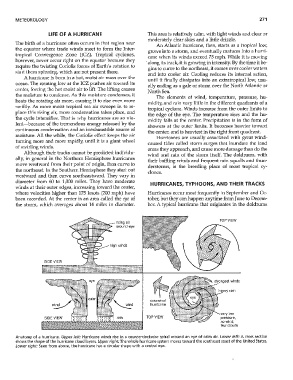
        Anatomy of a  hurricane.  Upper Jeft:  Hurricane winds  rise  in  a counterclockwise spiral  around  an  eye  of calm  air.  Lower left: A  cross section
        shows the shape of the hurricane cloud layers. Upper right: The whole hurricane system moves toward the southeast coast of the United States.
        Lower right: Seen  from above, the hurricane  has a circular shape with a central eye.

