


Page 275 - NS-2 Textbook
P. 275
270                                                                                     NAUTICAL SCIENCES


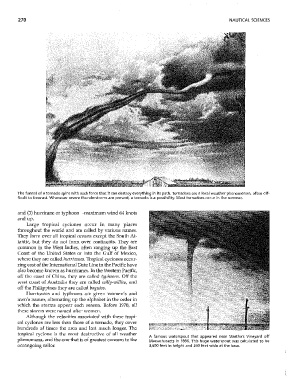
         The funnel of a tornado spins with such force that it can destroy everything in  its path. Tornadoes are a local weather phenomenon, often dif-
         ficult to forecast. Whenever severe thunderstorms are present, a tornado is  a possibility.  Most tornadoes occur in the summer.


         and (3) hurricane or typhoon-maximum wind 64 knots
         and up.
             Large  tropical  cyclones  occur  in  many  places
         throughout the world and are called by various names.
         They form over all tropical oceans except the South At-
         lantic,  but they do not form  over continents.  They  are
         common in the West Indies,  often ranging up the  East
         Coast  of the United States  or into  the Gulf of Mexico,
         where they are called izurricanes. Tropical cyclones occur-
         ring east of the International Date Line in the Pacific have
         also become known as hurricanes. In the Western Pacific,
         off the coast of China, they are called typhoons.  Off the
         west coast of Australia they are called willy-willies,  and
         off the Philippines they are called baguios.
             Hurricanes  and  typhoons  are  given  women's  and
         men's names, alternating up the alphabet in the order in
         which the storms  appear  each  season.  Before  1978,  all
         these storms were named after wonlen.
            Although the velocities associated with these tropi-
         cal cyclones are less than those of a tornado, they cover
         hundreds of times  the  area  and last much longer.  The
         tropical  cyclone  is  the  most  destructive  of all  weather   A  famous  waterspout  that  appeared  near  Martha's  Vineyard  off
         phenomena, and the one that is of greatest concern to the   Massachusetts  in  1896. This  huge waterspout was calculated  to be
         oceangoing sailor.                                     3,600 feet in  height and 240 feet wide at the base.

