


Page 289 - NS-2 Textbook
P. 289
284                                                                                      NAUTICAL SCIENCES

                                                                artificial satellites and other spacecraft sent into space on
                                                                scientific astronomical missions.
                                                                    Explorer I was fitted with a device designed to map
                                                                Earth's magnetic field by measuring the energies of in-
                                                                coming charged particles at different levels of the outer
                                                                ahnosphere.  Although it  failed  at this,  it succeeded  in
                                                                providing a COtillt of charged particles trapped in previ-
                                                                ously unknown bands around Earth far above the upper
                                                                ahnosphere-the now familiar Van Allen radiation belts.
                                                                    Since that time, many astronomical spacecraft have
                                                                been launched into space by NASA, by the former Soviet
                                                                Union, and by several other nations. Some of these, in-
                                                                cluding the Apollo missions of the late 1960s, the Ameri-
                                                                can Skylab orbited in 1973, the Russian MIR space station
                                                                that orbited between 1986 and 2001,  and most recently
                                                                the Illtemational Space Station, have been marmed. The as-
                                                                tronomical  data  and  new  knowledge  gained by  these
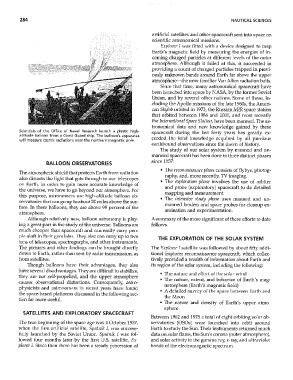
         Scientists  of  the  Office  of  Naval  Research  launch  a  plastic  high-  spacecraft  during  the  last  forty  years  has  greatly  ex-
         altitude balloon from  a Coast  Guard  ship.  The  balloon's apparatus
         will  measure cosmic radiations near the northern magnetic pole.   ceeded  the  total  knowledge  acquired  by  all  previous
                                                                earthbound observations since the dawn of history.
                                                                    The study of our solar system by manned and un-
                                                                manned spacecraft has been done in three distinct phases
                                                                since 1957:
                    BALLOON  OBSERVATORIES
                                                                    •  The reconnaissance phase consists of flybys, photog-
         The ahnospheric shield that protects Earth from radiation
                                                                      raphy, and, more recently, TV imaging.
         also distorts the light that gets through to our telescopes
                                                                    •  The  exploration  phase  involves  the  use  of  orbiter
         on Earth. In order to gain more accurate knowledge of
                                                                      and probe (exploratory) spacecraft to do detailed
         the universe, we have to go beyond our ahnosphere. For
                                                                      mapping and measurement.
         this purpose, astronomers use high-altitude balloon ob-
                                                                    •  The  intensive  study  phase  uses  marmed  and  un-
         servatories that can go up to about 20 miles above the sur-
                                                                      marmed landers and space probes for closeup ex-
         face.  In these balloons, they are above 99 percent of the
                                                                      amination and experimentation.
         ahnosphere.
             Although relatively new, balloon astronomy is play-  A summary of the more significant of these efforts to date
         ing a great part in the study of the universe. Balloons are   follows.
         much cheaper than spacecraft and can easily carry peo-
         ple aloft in their gondolas. They also can carry up to two
                                                                   THE  EXPLORATION OF THE  SOLAR SYSTEM
         tons of telescopes, spectrographs, and other instruments.
         The pictures and other findings can be brought directly   The Explorer I satellite was followed by about fifty addi-
         down to Earth, rather than sent by radio transmission, as   tional Explorer reconnaissance spacecraft, which collec-
         from satellites.                                       tively provided a wealth of information about Earth and
            1110ugh  balloons  have  their  advantages,  they  also   its region of the solar system, including the following:
         have several disadvantages. They are difficult to stabilize,
                                                                    •  The nahlre and effect of the solar wind
         they are not self-propelled,  and  the  upper  ahnosphere
                                                                    •  111e  nature, extent, and behavior of Earth's mag-
         causes  observational  distortions.  Consequently,  astro-
                                                                      netosphere (Earth's magnetic field)
         physicists  and  astronomers  in recent years  have  found
                                                                    •  A detailed survey of the space between Earth and
         the space-based platforms discussed in the following sec-
                                                                      the Moon
         tion far more useful.
                                                                    •  The  nahtre  and  density  of  Earth's  upper  ahno-
                                                                      sphere
           SATELLITES AND EXPLORATORY SPACECRAFT
                                                                Between 1962 and 1975 a total of eight orbiting solar ob-
         The true beginning of the space age was 4 October 1957,   servatories  (OSOs)  were  launched  into  orbit  around
         when the first artificial satellite, Sputllik I,  was success-  Earth to study the Still. Their insh'uments returned much
         fully  launched by  the  Soviet Union.  Sputnik I was fol-  data on solar flares, the Sun's corona (outer ahnosphere),
         lowed four  months later  by the  first  U.S.  satellite,  Ex-  and solar activity in the gamma ray, x-ray, and ultraviolet
         plorer 1.  Since then there has been a steady procession of   bands of the electromagnetic spectrum.

