


Page 290 - NS-2 Textbook
P. 290
ASTRONOMY                                                                                             285


                                  Science
                                            Plasma
                                                                               !OW..fJain antenna


                                                                                         Extendable
                                                                                         magnetometer
                                                                                         boom  \

                                                                                                    ,,- 4


                     spectr:ometer
                     and radiometer


                                    Scieh'ce instfllment
                                    caiibration panel
                                    and,'shunt radiator
                                                                             PlanetarY,radio
                                                                             astronomy and
                                                                             plasma \rvave
                                                                             antenna

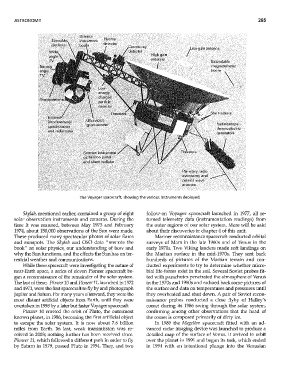
                                  The Voyager spacecraft,  showing the various instruments deployed.


           Sky/ab, mentioned earliel; contained a group of eight   follow-on  Voyager  spacecraft  launched  in  1977,  all  re-
       solar obsen'ation instruments and cameras. During the   nuned telemetry  data  (instrunlentation readings)  from
       time  it was manned, between May 1973  and February    the outer regions of our solar system. More will be said
       1974, about 150,000 observations of the Sun were made.   about their discoveries in chapter 4 of this unit.
       These produced many spectacular photos of solar flares     Mariner reconnaissance spacecraft conducted orbital
       and  sunspots.  The  Skylab  and  OSO  data  "rewrote  the   surveys of Mars in  the late 1960s  and of Venus  in the
       book" on solar physics, our ,mderstanding of how and   early 1970s. Two Viking landers made soft landings on
       why the Sun functions, and the effects the Silll has on ter-  the  Martian  surface  in  the  mid-1970s.  They  sent back
       restrial weather and communications.                   hundreds  of  pictlU'es  of  the  Martian  terrain  and  con-
           While these spacecraft were investigating the nature of   ducted experinlents to try to determine whether micro-
       near-Earth space, a selies of eleven Pioneer spacecraft be-  biallife-forms exist in the soil. Several Soviet probes fit-
       gan a reconnaissance of the remainder of the solar system.   ted with parachutes penetrated the atulOsphere of Venus
       The last of these,  Piolleer 10 and Piolleer 11, lmmched in 1972   in the 1970s and 1980s and radioed back some pictures of
       and 1973, were the first spacecraft to fly by and photograph   the surface and data on temperatures and pressures until
       Jupiter and Saturn. For many years afterward, they were the   they overheated and shut down. A pair of Soviet recon-
       most distant artificial  objects  from Earth,  until  they  were   naissance  probes  conducted  a  close  flyby  of  Halley's
       overtaken in 1998 by a later but faster Voyager spacecraft.   comet during its  1986 swing through the solar system,
           Piolleer  10 crossed the orbit of Pluto, the outermost   confirming among other observations  that  the head  of
       known planet, in 1986, becoming the first artificial object   the comet is composed primarily of dirty ice.
       to  escape  the  solar system.  It is  now  about 7.6  billion   In 1989  the  Magellall  spacecraft fitted  with an ad-
       miles  from  Earth.  Its  last,  weak  transmission  was  re-  vanced radar inlaging device was launched to produce a
       ceived in 2003; nothing further has been received since.   detailed map of the surface of Venus. It arrived in orbit
       PioHeer 11, which followed a different path in order to fly   over the planet in 1991  and began its task, which ended
       by Saturn in 1979, passed Pluto in 1994.  They,  and two   in  1994  with  an  intentional  plll'llge  into  the  Venusian

