


Page 294 - NS-2 Textbook
P. 294
ASTRONOMY                                                                                             289

       one-third of the lunar dust. Many scientists believe that
       the beads are congealed rock droplets, formed when me-
       teorites blasted the Moon and sent out a  spray of fine
       molten particles. The hmar dust layer, called the regolith,
       covers the entire surface of the Moon to a depth ranging
       from  a few  centimeters  to  100 meters  or more.  Various
       lunar landers and the Apollo astronauts found that it is
       rather loose on top and compacted underneath.
           The Lunar Receiving Laboratory of NASA in Hous-
       ton carefully examined all the hmar dust and rock sam-
       ples brought back by the Apollo expeditions. Some rocks
       appeared to be rich in magnesium; others sparkled with
       colorful  crystals.  When  scientists  burned  a  sample  of
       Moon  soil  and  studied  its  spectrograph,  they  fOlmd
       about sixty elements. TI,e Moon rocks appear to be rich
       in titanium, but with less than one-third of the sodium
       and potassium found in comparable  igneous  rocks  on
       Earth.

                 THE  SURFACE  OF THE  MOON

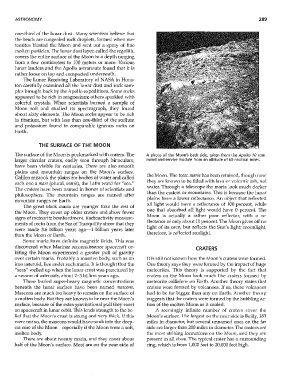
       The surface of the Moon is pockmarked with craters. The   A photo  of the Moon's  back  side,  taken  from  the Apollo  10 com-
       larger  circular  craters,  easily  seen  through  binoculars,   mand and service  module from an altitude of 60 nautical miles.
       have  been visible  for  centuries.  There  are  also  smooth
       plains  and  mountain  ranges  on  the  Moon's  surface.
                                                               the Moon. The term maria has been retained, though now
       Galileo mistook the plains for bodies of water and called
       each one a lIlare (plural, lIlaria), the Latin word for "sea."   they are known to be filled with lava or volcanic ash, not
                                                              water. Through a telescope the maria look much darker
       The craters have been named in honor of scientists and
                                                               than the craters or TI10lmtains.  111is  is because the hmar
       philosophers.  The  mountain  ranges  are  named  after
                                                               plains have a lower reflectance. An object that reflected
       mountain ranges on Earth.
           The great black maria are younger than the rest of   all light would have a reflectance of 100 percent, while
                                                               one that absorbed  all light  would  have  0 percent.  The
       the Moon. They cover up older craters and show fewer
                                                              Moon  is  actually  a  rather  poor  reflector,  'with  a  re-
       signs of meteorite bombardment. Radioactivity measure-
       ments of rocks from the Sea of Tranquility show that they   flectance of only about 11 percent. The Moon gives off no
                                                              light of its own, but reflects  the Sun's light; moonlight,
       were  made 3.6  billion  years  ago-l billion  years  later
                                                              therefore, is reflected sunlight.
       than the Moon or Earth.
           Some maria have definite lnagnetic fields.  This ·was
       discovered when Mariner reconnaissance spacecraft or-
                                                                                   CRATERS
       biting  the  Moon experienced  a  greater  pull  of  gravity
       over certain maria. Probably a massive body, such as an   It is still not known hmv the Moon's craters 'were formed.
       iron asteroid, lies under such maria. It is thought that the   One theOlY says they were formed by the inlpact of huge
       "seas" welled up when the lunar crust was punctured by   meteorites.  TIlis  theory  is  supported  by  the  fact  that
       a swarm of asteroids, about 2-3 billion years ago.     craters on the Moon look much like craters  formed  by
           These buried  super-heavy magnetic concentrations   meteorite collisions on Earth. Another theory states that
       beneath  the  hmar  surface  have  been  named  I1/aSCOIlS.   craters 'were formed by volcanoes. If so, these volcanoes
       Mascons are much too heavy to remain on the slu'face of   had to be far bigger than any on Earth. Another theory
       a molten body. But they are known to be near the Moon's   suggests that the craters were formed by the bubbling ac-
       surface, because of the extra gravitational pull they exert   tion of the molten Moon as it cooled.
       on spacecraft in hmar orbit. TI,is lends strength to the be-  A  seemingly  infinite  number  of  craters  cover  the
       lief that the Moon's crust is strong and very thick. If this   Moon's surface. The largest on the near side is Bailly, 183
       were not so, the nlascons vvould have sunk into the deep-  lniles in diameter, but several unnamed ones on the far
       est core of the Moon-especially if the Moon were a soft,   side are larger than 200 nllies in diameter. TI,e craters are
       molten body.                                           the most striking formations on the Moon, and they are
           There are about twenty maria, and they cover about   present in all sizes. The typical crater has a surrounding
       half of the Moon's surface. Most are on the near side of   ring, which is from 1,000 feet to 20,000 feet high.

