


Page 291 - NS-2 Textbook
P. 291
286                                                                                     NAUTICAL SCIENCES


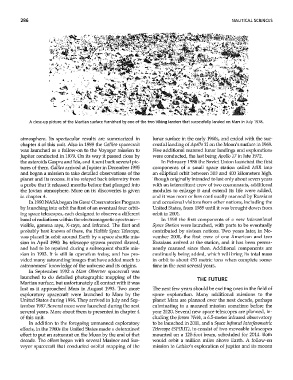
             A close-up picture of the Martian surface furnished by one of the two Viking  landers that successfully landed  on  Mars in  July  1978,


          atmosphere.  Its  spectacular  results  are  summarized  in   lunar surface in the early 1960s, and ended with the suc-
          chapter 4 of this unit. Also in 1989  the Galileo spacecraft   cessfullanding of Apollo 11 on the Moon's surface in 1969.
         was launched as a follow-on to the Voyager mission to   Five additional manned lunar landings and explorations
         Jupiter conducted in 1979. On its way it passed close by   were conducted, the last being Apollo 17 in late 1972.
          the asteroids Gaspra and Ida, and it sent back several pic-  In Februmy 1986 the Soviet Union lawlched the first
          tures of them. Galileo arrived at Jupiter in December 1995   components  of  a  small  space  station  called  MIR  into
          and began a mission to take detailed observations of the   an elliptical orbit between 300 and 400 kilometers high.
          planet and its moons. It also relayed back telemetry from   Though originally intended to last only about seven years
          a probe that it released months before that plunged into   with an intermittent crew of two cosmonauts, additional
          the Jovian atmosphere. More on its discoveries is given   modules to  enlarge it and extend its life  were  added,
          in chapter 4.                                          and it was more or less continually ma1ll1ed by Russians
             In 1990 NASA began its Great Observatories Program   and occasional visitors fronl other nations, including the
         by launching into orbit the first of an eventual four orbit-  United States, from 1989 tmtil it was brought down from
          ing space telescopes, each designed to observe a different   orbit in 2001.
         band of radiations within the electromagnetic spectrum-    In 1998  the  first  components of a new International
         visible, gamma rays, X-rays, and infrared. The first and   Space Station were launched, with parts to be eventually
          probably best known of these, the Hubble Space Telescope,   contributed by sixteen nations. Two  years later, in No-
         was placed in orbit around Earth by a space shuttle mis-  vember 2000,  the  first  crew  of one American and  two
          sion in April 1990.  Its  telescope system proved flawed,   Russians arrived at the station, and it has been perma-
          and had to be repaired during a subsequent shuttle mis-  nently  manned since  then.  Additional components are
          sion in 1993.  It is  still in operation today, and has pro-  continually being added, which will bring its total mass
         vided many astounding images that have added much to    in orbit to about 453  metric tons when complete some-
          astronomers' knowledge of the universe and its origins.   time in the next several years.
             In September 1992  a  Mars  Observer  spacecraft was
          launched  to  do  detailed  photographic mapping of  the
                                                                                   THE  FUTURE
         Martian surface, but wlfortunately all contact with it was
         lost as it approached Mars in August 1993.  Two  more   The next few years should be exciting ones in the field of
          exploratory  spacecraft  were  launched  to  Mars  by  the   space  exploration.  Many  additional  missions  to  the
         United States during 1996. TIley arrived in July and Sep-  planet Mars are planned over the next decade, perhaps
          tember 1997. Several more were launched during the next   culminating in a  manned mission sometime before  the
         several years. More about them is presented in chapter 4   year 2020. Several new space telescopes are planned, in-
          of this unit.                                          cluding the James  Webb, a 6.5-meter infrared observatory
             In addition to the foregoing unmanned exploratory   to be launched in 2011, and a Space Infrared Interferometric
         efforts, in the 1960s the United States made a determined   Telescope (SPIRIT), to consist of two moveable telescopes
         effort to put an astronaut on the Moon by the end of that   mounted on a 120-foot bea1ll,  scheduled for  2014.  Both
         decade. The effort began with several Mariner and Sur-  would  orbit  a  million miles  above  Earth.  A  follow-on
         veyor spacecraft that conducted orbital mapping of the   mission to Galileo's exploration of Jupiter and its moons

