


Page 343 - NS-2 Textbook
P. 343
338                                                                                     NAUTICAL SCIENCES


          sound in terms of its power per unit area,  as  described
          above, there is another 'widely used meaSUl'e of sound in-
          tensity  relative  to  the  quietest  sound  the ear can hear.
          This measure, called relative illtellsity or lIoise level, is cal-
          culated in units called decibels. A sound having 0 decibels
          is equal in intensity to the lowest that can be heard, 10- 12
          walts per square meter. On the decibel scale a sound of
                                10
          100 decibels would be 10 times as intense as a sound of
          o decibels. A sDtmd of 120 decibels is the loudest sound
          that the ear can stand without pain as the eardrum be-
          gins to tear. Sound decibel levels that are negative indi-
          cate a sDtmd that is too faint to be heard without ampli-
          fication, as for example, distant fish sounds in the ocean.


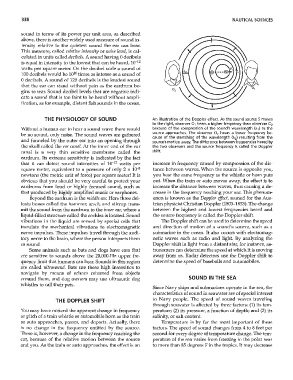
                    THE  PHYSIOLOGY OF  SOUND                    An  illustration  of the Doppler effect As the sound source 5 moves
                                                                 to the right, observer 0 1  hears a higher frequency than observer Oz
          Without a human ear to hear a sound wave there would   because of the compression  of the sound's wavelength  (h,)  as the
          be no sOlmd, only noise. The sound waves are gathered   source  approaches.  The  observer  Oz  hears  a  lower  frequency  be-
                                                                 cause  of the stretching of the wavelength  (hz)  resulting  from  the
          and funneled by the outer ear into an opening through   source's motion away. The difference between frequencies heard by
          the skull called the ear calla I.  At the inner end of the ear   the two observers and  the source  frequency  is  called  the  Doppler
          canal  is  a  very  thin  sensitive  membrane  called  the   shift.
          eardrum. Its extreme sensitivity is indicated by the fact
          that it can  detect  sOlmd  intensities  of  10- 12   watts  per   increase in frequency caused by compression of the dis-
          square metel; equivalent to  a  pressure of only 2 x  10- 5   tance benveen waves. When the SOUl'Ce is opposite you,
          newtons (the metric emit of force) per square meter! It is   you hear the same frequency as the whistle or horn puts
          obvious that you should be very careful to protect yom   out. When the train or auto moves away, the effect is to
          eardrums from  loud  or highly focused  sOlmd,  such as   increase the distance betvveen waves, thus causing a de-
          that produced by highly amplified music or earphones.   crease in the frequency reaching your ear. This phenom-
              Beyond the eardrum is the middle ear. Here three del-  enon is known as the Doppler effect,  named for the Aus-
          icate bones called the hanunel~ anvil, and stilTUP  trans-  trian physicist Christian Doppler (1803-1853). The change
          mit the sound from the eardrum to the illller ear, where a   between the highest and lowest frequencies heard and
          liquid-filled structure called the cochlea is located. Sound   the source frequency is called the Doppler shift.
          vibrations in the liquid are sensed by special cells that   The Doppler shift can be used to determine the speed
          translate  the  mechanical  vibrations  to  electromagnetic   and  direction of motion of a  sound's source, such as  a
          nerve impulses. These impulses travel through the audi-  submarine in the ocean. It also occurs with electromag-
          tory nerve to the brain, where the person interprets them   netic waves such as  radio and light.  By  analyzing  the
          as sound.                                              Doppler shift in light from a distant star, for instance, as-
              Some animals such as bats and dogs have ears that   tronomers can determine the speed at which it is moving
          are sensitive  to  sowlds above the 20,000-Hz  upper fre-  away from us. Radar detectors use the Doppler shift to
          quency limit that hlilllans can hear. SDtmds in this region   determine the speed of baseballs and automobiles.
          are  called ultrasoulld.  Bats  use  these high intensities  to
          navigate  by  means  of  echoes  returned  from  objects
          around them, and dog owners may use ultrasonic dog                    SOUND IN THE  SEA
          whistles to call their pets.
                                                                 Since Navy ships and submarines operate in the sea, the
                                                                 characteristics of sound in seawater are of special interest
                         THE  DOPPLER  SHIFT                     to  Navy  people.  The  speed  of sound  waves  traveling
                                                                 through seawater is affected by three factors: (1) its tem-
          You may have noticed the apparent change in frequency   perature; (2) its pressme, a function of depth; and (3)  its
          or pitch of a train whistle or automobile horn as the train   salinity, or salt content.
          or auto approaches, passes, and departs. Actually, there   Temperature is by far  the most important of these
          is  no  change  in  the  frequency  emitted  by  the  source.   factors. The speed of sound changes from 4 to 8 feet per
          There is, ho,vever, a change in the frequency reaching the   second for every degree of temperature change. The tem-
          ear,  because of the  relative  lllotion between the  source   perahlre of the sea varies from freezing in the polar seas
          and you. As the train or auto approaches, the effect is an   to more than 85 degrees F in the tropics. It may decrease

