


Page 344 - NS-2 Textbook
P. 344
PHYSICAL SCIENCE                                                                                      339


                                                              deeper a sOlmd ·wave is,  the faster it travels.  This pres-
                                                              sure effect is smaller than temperature effect, but it can-
                                                              not be neglected, since it increases about 2 feet per sec-
                                                              ond for each 100 feet of depth.
                                                                  Seawater  has high mineral content or salillity.  11,e
                                                              density of seawater is  about 64  pOlmds per cubic foot;
                                                              that of fresh  water is  only about 62.4  pounds per cubic
                                                              foot. This variation is the result of the salt content in the
                                                              seawater.  The  saltier  the  'vatel~ the  greater  its  density,
                                                              and hence the faster the speed of sound in it. The speed
                                                              of sOlmd increases about 4 feet per second for each part-
                                                              per-thousand  increase  in  salinity-a lesser  effect  than
                                                              that of temperature, but greater than that of pressure.

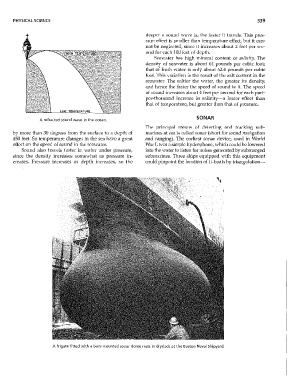
                                                                                    SONAR
                  A refracted sound wave in the ocean.
                                                              The  principal  means  of  detecting  and  tracking  sub-
       by more than 30 degrees from the surface to a depth of   marines at sea is called sonar (short for sOillld navigation
       450 feet.  So temperature changes in the sea have a great   and  ranging).  The  earliest sonar device, used in World
       effect on the speed of sound in the seawater.          War I, was a simple hydrophone, which could be lowered
           Sound  also  travels  faster  in water  lUlder  pressure,   into the water to listen for noises generated by submerged
       since  the  density  increases  somewhat  as  pressure  in-  submarines. Three ships equipped with this equipment
       creases.  Pressure  increases  as  depth  increases,  so  the   could pinpoint the location of U-boats by triangulation-


                        A frigate fitted with a bow-mounted sonar dome rests in  drydock at the Boston  Naval  Shipyard.

