


Page 345 - NS-2 Textbook
P. 345
340                                                                                     NAUTICAL SCIENCES


           plotting the bearings of the hydrophone noise from the
           three ships and seeing where the bearings crossed.
              Today's  sonar  gear  is  much more  sophisticated.  It
           provides highly accurate ranges and bearings to the sub-
           merged submarine. Analysis of Doppler data provides
           accurate  courses  and  speeds  for  the  submarine.  The
           sonar  information  is  normally  presented  visually  on  a
           CRT screen rather than by sotmd as the early devices did.
           In  addition,  very sophisticated sonars  for  use by heli-
           copters and fixed-wing aircraft have been developed.
              There are two basic modes of operation of sonar sys-
           tems employed for the detection of targets. They are re-
           ferred to as active and passive.
              Active sonars transmit underwater sound pulses that
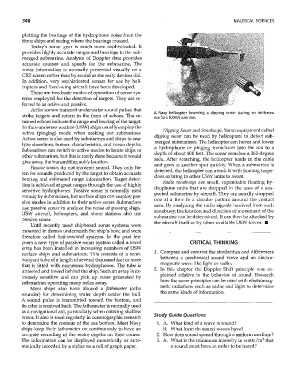
                                                                  A  Navy  helicopter  lowering  a  dipping  sonar  during  an  undersea
           strike  targets and return in the form of echoes.  The re-
                                                                  warfare (U5W) exercise.
           turned echoes indicate the range and bearing of the target.
           Surface undersea warfare (USW) ships usually employ the
                                                                     Dippiilg Sonar and SOllobuoys. Sonar equipment called
           active  (pinging)  mode  when  seeking  out  submarines.
                                                                  dippillg  SOilar  can be used by helicopters  to  detect sub-
           Active sonar is also used by submarines and ships to ana-
                                                                  merged submarines. The helicopter can hover and lower
           lyze shorelines, bottom characteristics, and ocean depths.
                                                                  a  hydrophone  or  pinging  transducer into  the  sea  to  a
           Submarines can switch to active modes to locate ships or
                                                                  depth of about 400 feet. The sonar searches a 360-degree
           other submarines, but this is rarely done because it would
                                                                  area. After  searching,  the helicopter hauls in the  cable
           give away the transmitting sub's location.
                                                                  and goes to another spot quickly. When a submarine is
              Passive sonars do not transmit sound. They only lis-
                                                                  detected, the helicopter can attack it with homing torpe-
           ten for sounds produced by the target to obtain accurate
                                                                  does 01' bring in other USW units to assist.
          bearing and estimated range information. Target detec-
                                                                     Radio  SOitobuoys  are  small, expendable floating  hy-
           tion is achieved at great ranges through the use of highly
                                                                  drophone units  that are  dropped  in the  area  of a  sus-
           sensitive hydrophones.  Passive sonar is normally used
                                                                  pected submarine by aircraft. They are usually dropped
           mainly by submarines, but surface ships can employ pas-
                                                                  one at a  time  in a  circular pattern around  the  contact
           sive modes in addition to their active sonar. Submarines
                                                                  area. By analyzing the radio signals received from each
           use passive sonar to analyze the noise of passing ships.
                                                                  sonobuoy, the location and direction of movement of the
           USW  aircraft,  helicopters,  and  shore  stations  also  use
                                                                  submarine can be determined. It can then be attacked by
           passive sonar.
                                                                  the aircraft itself or by other available USW forces.  III
              Until  recently most shipboard sonar systems were
           mounted in domes underneath the ship's bow, and were   -_ ..  _--
          therefore  called  lIul/-mounted  systems.  In the  past few
          years a new type of passive sonar system called a towed                CRITICAL THINKING
          array has been installed in increasing numbers of USW
                                                                  1.  Compare and contrast the similarities and differences
          surface ships and  submarines.  This  consists  of a  semi-
                                                                    between  a  mechanical  sound  'wave  and  an  electro-
           buoyant tube of a length of several thousand feet or more
                                                                    magnetic wave like light or radio.
          that is fitted  with numerous hydrophones.  The  tube is
                                                                  2.  In this  chapter  the  Doppler  Shift  principle  was  ex-
           unreeled and towed behind the ship. Such an array is ex-
                                                                    plained  relative  to  the  behavior  of  sound.  Research
          tremely  sensitive  and  can pick up noise  generated by
                                                                    how the same principles can be used with electromag-
          submarines operating many miles away.
                                                                    netic radiations such as radar and light to determine
              Most  ships  also  have  aboard  a  fat/tometer  (echo
                                                                    the same kinds of information.
          sounder)  for  detelmining  water  depth  under  the  hull.
          A  sound  pulse  is  h'ansmitted  toward  the  bottom,  and   -_ .•. _--
          its echo is received back. The fathometer is normally used
          as a navigational aid, particularly when entering shallow   Study Guide Questions
          water. It also is used regularly in oceanographic research
          to  determine the contour of the sea bottom. Most Navy   1.  A.  What kind of a wave is sound?
          ships keep their fathometer on continuously to have an     B.  What form do sound waves have?
          accurate recording of the water depths on their course.   2.  How does sound spread through a uniform medium?
          The information can be displayed numerically or auto-    3.  A.  What is the minimum intensity in watts/m that
                                                                                                               2
          matically recorded by a stylus on a roll of graph paper.       a sound must have in order to be heard?

