


Page 67 - NS-2 Textbook
P. 67
60                                                                                      MARITIME HISTORY


                THE  SPANISH-AMERICAN WAR OF  1898                plosion, even though the Spanish govenunent expressed
                                                                  sympathy and denied any part in the incident. Several
           For  years  Americans  had  resented  Spain's  harsh  rule   shIdies in recent years have indicated that the probable
           over  Cuba,  the  most important Spanish  colony  in  the   cause was a coal dust explosion in a forward coal bunker,
           New World. Cuban revolutionaries had been inciting in-  which set off ammunition in a nearby magazine. In any
           surrections against this rule for more than twenty years,   event,  the  loss  of  the  MaiJ1e  brought the  nation  to  the
           which by 1895 had resulted in a state of near anarchy and   brink of war with Spain.
           open rebellion. Spanish authorities had been ruthless in   Although both nations h'ied to head off war with fur-
           their attempts to suppress the rebellion and retain con-  ther negotiations over the next couple of months, neither
           trol of the island, resulting in the killing of thousands of   had much doubt that war was inevitable.  On 19  April
           civilians. Partly in response to this human suffering, and   Congress  passed four  resolutions:  declaring  Cuba free
           certainly  because  of  ecollmnic  concern  over  some  $50   and independent, demanding withdrawal of all Spanish
           million  "vorth  of  American  investment  in  sugar  cane   forces,  guaranteeing  that the  United  States  would  not
           plantations and $100 million in annual sugar trade, sup-  annex Cuba, and directing the president to use American
           port grew for the United States to intervene in Cuba, per-  armed forces to enforce these resolutions.
           haps even to  annex it frOlll Spain, by force  if necessary.   Under  the  leadership  of Assistant Secretary  of  the
           Yellow journalism (stories ·written to incite an emotional   Navy Theodore Roosevelt, the Navy prepared for  war.
           response) in U.S. newspapers, including publication of a   Recognizing that the Spanish-owned Philippine Islands
           letter  stolen  from  the  Spanish  ambassador  describing   in the Pacific region could become a key U.S. base to pro-
           President  McKinley  as  "weak,"  further  whipped  up   tect  its  Asian  trade,  in late  February Roosevelt  cabled
           American feelings in support of war with Spain.        Commodore George  Dewey in his  flagship  Olympia  at
              In February 1898 McKinley sent the battleship USS   Hong Kong to make ready the U.S. Asiatic Fleet to attack
           MaiJ1e to Havana to protect American lives and property.   the Spanish fleet at Manila. Roosevelt backed up the in-
           On the evening of 15 February a tremendous explosion   struction by rushing the cruiser Baltimore across the Pa-
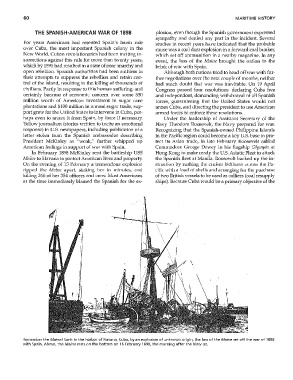
           ripped  the  MaiJ1e  apart,  sinking  her  in  minutes,  and   cific with a load of shells and arranging for the purchase
           killing 266 of her 354 officers and crew. Most Americans   of two British vessels to be used as colliers (coal resupply
           at the time immediately blamed the Spanish for the ex-  ships). Because Cuba would be a primary objective of the


           Remember the Maine! Sunk in the harbor of Havana,  Cuba, by an  explosion of unknown origin, the loss of the Maine set off the war of 1898
           with Spain.  Above, the Maine rests on the bottom on  16 February  1898, the morning after she  blew up.

