


Page 68 - NS-2 Textbook
P. 68
THE  RISE TO WORLD  POWER STATUS                                                                       61


      war and Puerto Rico a close second, the bulk of the u.s.   chance at sea, so he planned to fight at anchor under the
      fleet was concentrated in the Atlantic. In mid-March the   shore batteries at Cavite, a naval station south of Manila.
      new battleship Oregoll, just being completed in San Fran-  Shortly  after  lnidnight  on  1  May  1898  Dewey's
      cisco,  ,vas  ordered  to  leave  immediately and begin an   squadron slipped into the entrance of Manila Bay past
      amazing 15,000-mile trip in sixty-six days to join the u.s.   the fortified island of Corregidor and made for Manila,
      Atlantic Fleet by way of Cape Horn.                     22  miles  across  the  bay.  As  dawn  broke,  the  enemy
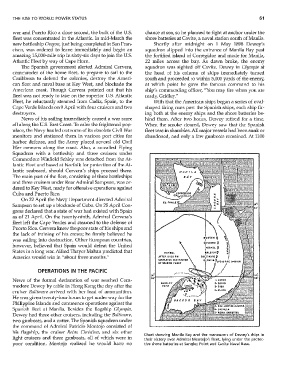
          The  Spanish governnlent alerted Admh'al  Cenrera,   squadron was sighted off Cavite.  Dewey in Olympia  at
      commander of the home fleet,  to prepare to  sail to  the   the  head  of  his  column  of  ships  immediately  turned
      Caribbean  to  defend  the  colonies,  destroy  the  Ameri-  south and proceeded to within 5,000 yards of the enemy,
      can fleet and naval base at Key West, and blockade the   at  which  point  he  gave  the  famous  command  to  his
      American  coast.  Though  Cervera  pointed  out  that  his   ship's comnlilllding officel~ "You may fire when you are
      fleet was not ready to take on the superior U.s. Atlantic   ready, Gridley."
      Fleet, he reluctantly steamed from Cadiz, Spain, to the    With that the American ships began a series of oval-
      Cape Verde Islands on 9 April with four cruisers and two   shaped firing runs past the Spanish ships, each ship fir-
      destroyers.                                             ing both at the enemy ships and the shore batteries be-
          News of his sailing immediately caused a ·war scare   hind them. After two hours, Dewey retired  for  a  time.
      all along the U.S. East Coast. To calm the frightened pop-  When the smoke cleared, Dewey saw that the Spanish
      ulace, the Navy hauled out some of its obsolete Civil War   fleet 'vas in shmnbles. All nlajor vessels had been sunk or
      monitors  and  stationed  them in various  port  cities  for   abandoned, and only a few  gunboats remained. At 1100
      harbor defense, and the Army placed several  old Civil
      War  cannons  along  the  coast.  Also,  a  so-called  Flying
      Squadron  with  a  battleship  and  three  cruisers  lmder
      Commodore Winfield Schley was detached from the A t-
      lantic Fleet and based at Norfolk for protection of the At-
      lantic  seaboard,  should  Cen'era's  ships  proceed  there.
      The main part of the fleet, consisting of three battleships
      and three cruisers under Rear Adnllial Sampson, ,vas or-
      dered to Key West, ready for offensive operations against
      Cuba and Puerto Rico.
          On 22 April the Navy Department directed Admiral
      Sampson to set up a blockade of Cuba. On 25 April Con-
      gress declared that a state of war had existed with Spain
      as of 21  April.  On the  hventy-ninth, Admiral Cervera's
      fleet left the Cape Verdes and steamed to the defense of
      Puerto Rico. Cen'era knew the poor state of his ships and
      the lack of training of his crews; he firmly believed he
      was sailing into destruction. Other European countries,
      however, believed that Spain would defeat the  United
      States in a long war. Alfred Thayer Mahan predicted that
      America would win in "about three months."


                 OPERATIONS IN THE  PACIFIC
      News  of  the  formal  declaration  of war reached  Com-
      modore Dewey by cable in Hong Kong the day after the
      cruiser  Baltimore  arrived  ,,,ith her load  of anlmunition.
      He ,vas given hventy-four hOlITS to get tmder ·way for the
      Philippine Islands and commence operations against the
      Spanish  fleet  at Manila.  Besides  the  flagship  Olympia,
      Dewey had tlu-ee other cruisers, including the Baltimore,
      rno gunboats, and a cutter. The Spanish squadron lmder
      the command of Admiral Patricio Montojo consisted of
      his  flagship,  the  cruiser  Reilla  Cllristilla,  and  six  other
                                                             Chart  showing  Manila  Bay  and  the  maneuvers  of Dewey's  ships  in
      light cruisers  and three gtmboats, all of which were in   their victory over Admiral  Montojo's fleet,  lying  under the  protec-
      poor  condition.  Montojo  realized  he  would  have  no   tive shore batteries at Sangley Point and Cavite Naval Base.

